

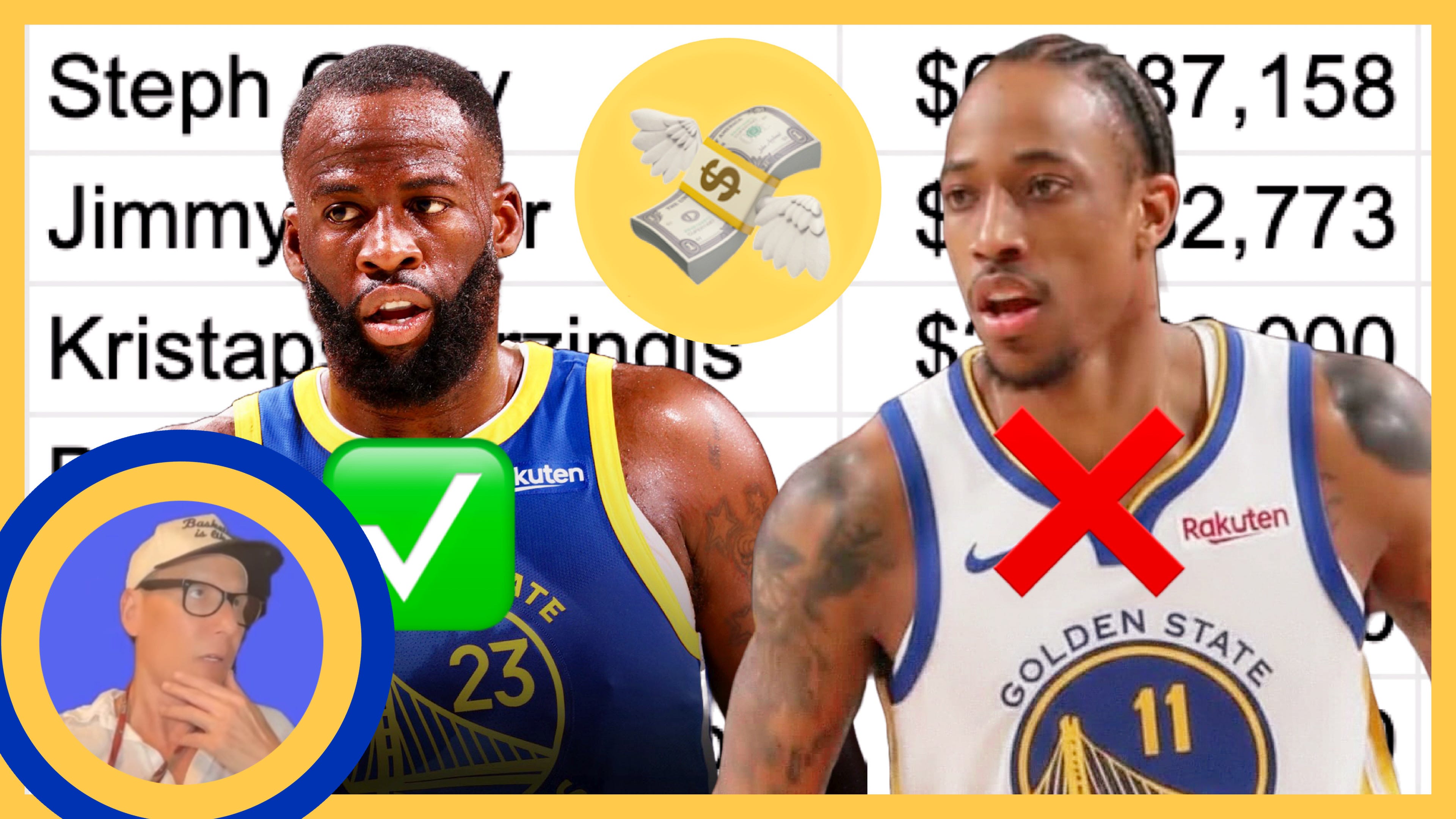
Here’s the number I couldn’t stop thinking about after this week’s livestream with Dean “of Positivity” Chambers:
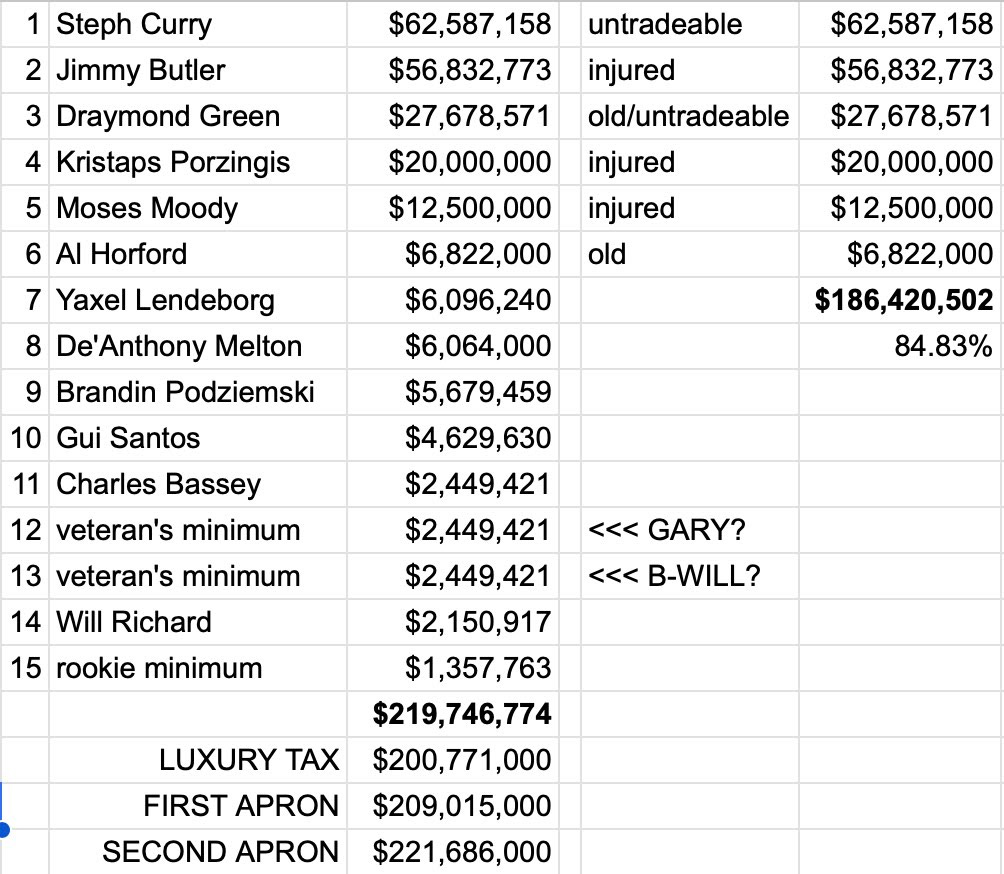
Approximately 85% of the Warriors’ committed salary is tied up in players who are either injured, aging, or both.
Once you start from that reality, almost every offseason rumor looks different.
When Draymond Green re-signed at essentially his original salary, it looked like a quiet piece of business. The reaction across social media was almost the opposite. Many fans immediately concluded the Warriors had “run it back,” that Joe Lacob — and, oddly, not so much Mike Dunleavy, Jr. — had failed one Wardell Stephen Curry II, and effectively conceded the season.
After spending another livestream going through the salary cap with Dean, I actually came away with a different conclusion because the cap sheet tells a more interesting story than the transaction wire.
Want to see every spreadsheet iteration?
The embedded video above is the distilled conclusion. If you’d like to follow every cap-sheet calculation and alternate path Dean Chambers and I explored live, here’s the full archived livestream (with chapters/timestamps so you can skip around to various topics):
Earlier this week, it appeared there might still be a path toward using the Non-Taxpayer Mid-Level Exception on DeMar DeRozan, as the plan all along had been to grant LeBron James that $15 million slot.
That possibility depended on several things happening one after the other Green would have needed to opt out and re-sign at a significantly lower first-year salary. But with James choosing to join Philadelphia on a much lower available contract at his veteran’s minimum of roughly $4 million, the NTMLE the Warriors freed up as a result of Draymond’s generosity could instead be offered to DeRozan. We originally discussed that here:
The Warriors would have needed to prioritize immediate improvement over maintaining future flexibility. Once Dray re-signed at his previous figure, most of those branches disappeared.
The “Decision Tree” became much simpler. One point Dean and I kept coming back to was Moses Moody.
Trading Moody to create room for an aging veteran sounds attractive on paper, particularly after another disappointing postseason and, well, the fact that Moody is injured at least for another few months.
But Moody isn’t simply a rotation player. He’s also one of the Warriors’ few meaningful salary slots that projects to still have value heading into Summer 2027. That’s a very different conversation than simply asking whether DeRozan is better than Moody today.
The Warriors’ roster also presents another challenge that doesn’t receive enough attention. Roughly 85 percent of their committed salary is tied up in players who are either:
veterans,
recovering from injuries,
or both.
That’s a difficult roster to trade from. It’s easy to say the front office should “make a move.” It’s much harder to identify the team that actually wants to absorb those contracts without demanding significant assets in return.
Viewed through that lens, standing pat starts looking less like passivity and more like realism. That doesn’t mean the offseason is over. There is still room for veteran minimum additions.
Gary Payton II, whose re-signing was just announced, always was a logical possibility due to his willingness to play for a veteran’s minimum and his stellar and durable 2025-26 campaign in which he played in 73 games.
Brandon Williams continues to intrigue me because of what he could add as a downhill scoring guard. We discussed him at length here:
Do the Warriors have Brandon Williams in their back pocket?

There may very well be a “transaction after the transaction” waiting in the wings as LeBron James mulls his decision. We’ve already discussed how likely it is that the Warriors would have to get off of Moses Moody’s contract should the Non-Taxpayer Mid-Level be utilized — and, no, the contract of
As of this writing, I do not have any additional intel to figure out why Williams has not been signed yet. He could very well have an offer from another team in which there are other things they need to wait on. Perhaps it has something to do with the limbo status that Peyton Watson, Jonathan Kuminga and Bennedict Mathurin find themselves in, as those are all players expected to get salaries in that NTMLE range, whereas Williams is probably looking at between veteran’s minimum and Taxpayer Mid-Level Exception (roughly $6 million) offers.
But the blockbuster paths that existed several weeks ago have largely closed, namely LeBron.
What makes this interesting is that the Warriors’ long game may now be more important than the next few weeks. Rather than forcing a move simply to satisfy the offseason conversation, they may be positioning themselves for greater flexibility later.
That includes the February trade deadline and, perhaps even more importantly, Summer 2027. Those will be the next branches of the Decision Tree.
What do you think?
Would you have sacrificed future flexibility to chase DeRozan? Or do you think preserving the cap sheet gives Curry a better chance to compete over the next two seasons?
The spreadsheet behind today’s analysis started as a live Decision Tree session with Dean Chambers. As the offseason continues, I’m also experimenting with shorter written analyses here on Substack, while using our Discord “Knowledge Base” to collect the daily developments that eventually become these articles and videos. Thanks for reading and for following along.