

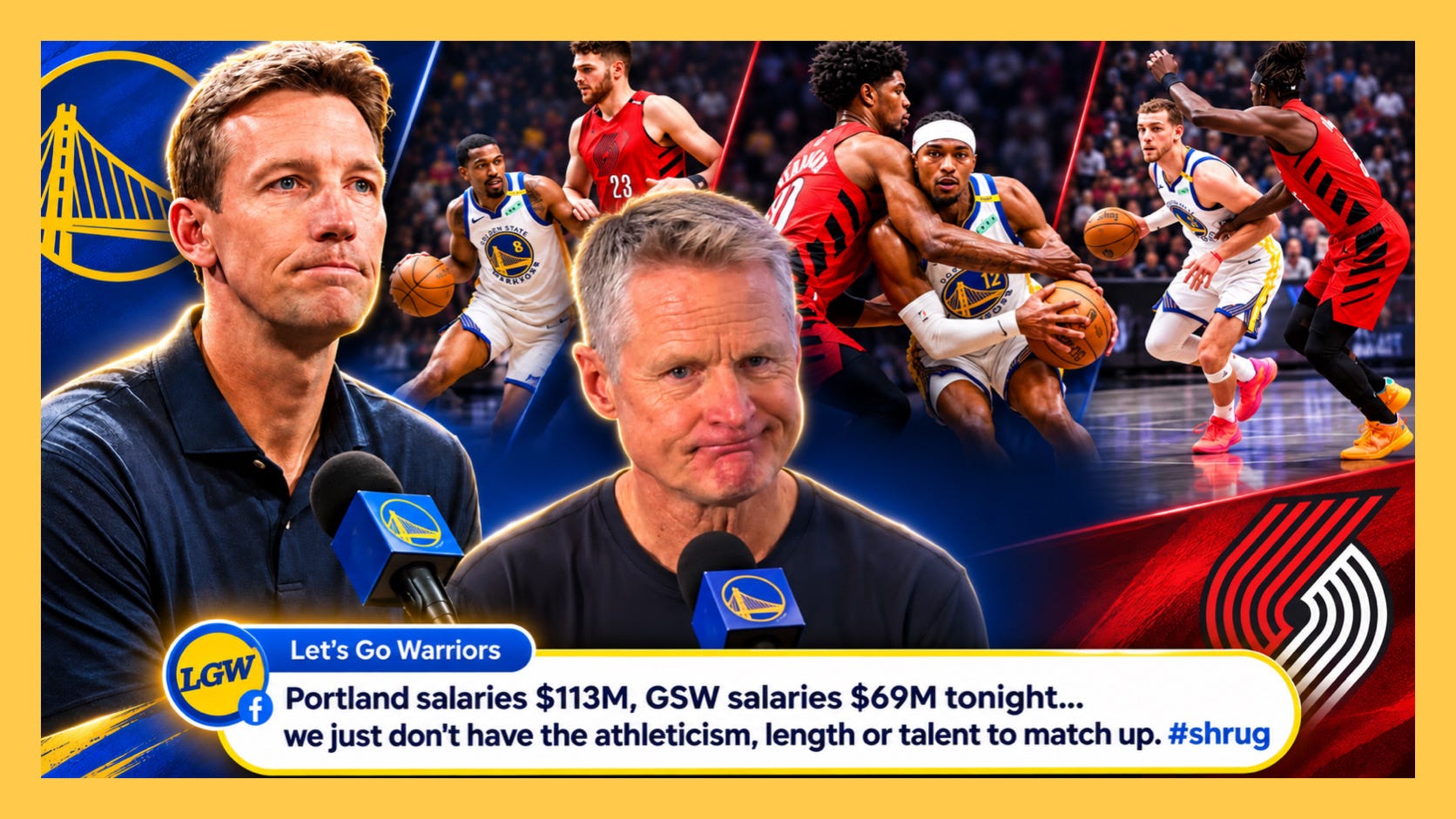
Before the Warriors tipped off against the Trail Blazers in Portland, Steve Kerr was asked about Jrue Holiday, whom he coached with Team USA.
“He’s the ultimate Swiss Army knife. He can guard anybody,” Kerr said. “You can put him on a big guy, and he’s so strong that he’s not going to get overpowered on the block, but he guards equally as well on-ball, off-ball. He’s a ballhandler, but he’s very comfortable just playing in the corner and shooting threes.”
Little did we know just how applicable that description would become to our postgame discussion about the next iteration of the Golden State Warriors. Holiday hit a couple daggers to put the game away, late.
And Jrue also opened the game with a right corner three. De’Anthony Melton turned the ball over on the ensuing possession, Deni Avdija went the other way and, before we could really get settled into our Watch Party, it was 5-0.
The Warriors committed three turnovers in the first four and a half minutes, putting them on pace for an absurd 32 turnovers over 48 minutes. Portland eventually led 37-11 after the first quarter and 47-11 early in the second.
And yet, as has been the case throughout much of this stretch without one Wardell Stephen Curry II, there were multiple layers to what we were watching.
Meeting force with force
“We’re just not bringing the necessary force and focus to start games,” Kerr said afterward. “We’re getting killed in the first quarter over and over again, and so we’ve got to find the execution to deal with the pressure.”
At one point in the first quarter, with Portland applying fullcourt pressure, Kerr had to instruct his players to come back and get the ball. It reminded me of the days when we were playing high school basketball and suddenly realized nobody had come back to help break the press.
But what exactly is required to deal with that pressure at the NBA level?
Luca Evans of the San Francisco Chronicle had some particularly insightful locker room reporting afterward.
“I mean, teams are coming up, coming out with so much pressure — it’s kinda like a shock,” Draymond Green told Evans. “I think you gotta meet — like anything — you meet force with force. You meet force with force, you can overcome it. But I feel like we’re not meeting force with that same force, and it’s digging a hole for ourselves.”
What constitutes force on a basketball court? Certainly, there’s a mental component to it. There’s also proper spacing, anticipating pressure, coming back to help your teammates and making the correct reads, but there’s also an individual talent component to it. Sometimes you simply have to be able to go by somebody.
“We don’t have ballhandlers out there,” Brandon Williams told Evans. “Like, you need ballhandlers out there. It’s obvious, so. You just need guys that can handle the ball. Um, yeah. Simple as that.”
This is especially interesting considering some of our recent coverage of Williams, including the Ferrari vs. Road Runner discussion following the Sacramento game, and Kerr’s description of what makes Williams different: “He’s just gone.”
B-Dub can get past that initial defender in a way that few of his currently healthy teammates can.
We discussed some of those attributes in our previous coverage of B-Dub, Kyrie Irving and the Warriors’ team culture:
Brandon Williams on Kyrie vs. Steph Curry team culture + more from Warriors practices

One of the nice things about the Warriors having two consecutive days of practice following their win over the Boston Celtics is that we got to hear from some guys we don’t normally get to hear from.
Unfortunately, Williams played only 13 minutes in Portland, spread across several rather short stints. Given his recent return from a hamstring injury, I wondered during the Watch Party if he was on some sort of minutes restriction. We don’t know that for certain.
Nevertheless, his comments to Evans provide additional insight into why having Williams healthy and available for more substantial minutes could help change the dynamic of this particular Golden State team.
Can execution overcome talent issues?
The Dubs did eventually cut that 36-point deficit to 10, which shouldn’t get completely lost in the discussion.
“We rebounded really well from that terrible start and outscored them by 25 or so during the middle couple quarters and part of the fourth,” Kerr said. “So I was proud of the guys’ response, but we have to start games better.”
There were some encouraging stretches. Melton started hitting threes. Charles Bassey continued to demonstrate an impressive ability to hit those push shots, even over the enormous standing reach of Donovan Clingan. Yaxel Lendeborg recovered a loose ball, went behind his back and dunked on Holiday for an and-one.
The Warriors never quite got the deficit into single digits, though. Throughout the Detail Recap, we kept coming back to a familiar topic from our coverage during Steph’s absence: the salary disparity and, by extension, the disparity in available talent.
Consider that Holiday alone accounts for roughly $35 million in salary. Add Toumani Camara and Robert Williams III, and you’re already in the neighborhood of $66 million before accounting for Avdija, Scoot Henderson, Clingan and the rest of Portland’s available rotation. Meanwhile, the Warriors’ five starters accounted for approximately $69 million in salaries.
Salary isn’t necessarily a perfect measurement of talent, of course. Avdija himself is an example of someone whose production far exceeds what his current contract might suggest, but it does provide some context for the amount of established NBA talent Golden State is missing right now.
Watching these particular teams play against each other, it wasn’t difficult to see the difference. There were instances in which a Warrior made the correct basketball play, only to be thwarted by somebody with considerably more length. Yaxel actually did a good job boxing out Clingan on one second-quarter possession, but Clingan’s reach enabled him to get a fingertip on the ball anyway, leading to a Micah Potter and-one putback.
There were other instances where the Warriors swung the ball around the perimeter, got Portland’s defense scrambling and still couldn’t capitalize. Having played in and organized competitive basketball leagues in the Bay Area for over two decades, I’ve seen variations of this phenomenon countless times. You can have a group of guys who know how to play basketball together, but sometimes the other guys are just bigger, faster, stronger or more individually talented.
That doesn’t absolve you of your responsibility to execute. It does, however, help establish more realistic expectations for what that execution can accomplish.
Youth, athleticism, length, talent
This brings us back to Mike Dunleavy, Jr. and the summer of 2027, something we’ve been discussing extensively on our livestreams and in our salary-cap coverage. Have we reached the point where the Warriors already have enough players who fit with Steph?
Depending on how this season plays out and what happens contractually, there’s a possibility that Draymond and Jimmy Butler (with their over-the-top praise of the organization), plus Melton and Al Horford (due to their player options), could all be part of the next iteration of the roster.
Gui Santos, at approximately $5 million, is an absolute bargain in my estimation. Yaxel is developing into somebody who could conceivably fit into just about any offensive ecosystem. Will Richard is on a relatively inexpensive second-round contract, and hopefully we’ll continue to see the development of B-Dub, who could maybe stick around with his buddy Melt likely to be here due to the player option.
That’s potentially quite a few pieces that either already complement Steph or are learning how to do so. Perhaps the evolution for Dunleavy this summer is to place youth, length, athleticism and individual talent ahead of fit with Curry when evaluating additional acquisitions, because we may already have enough players that fit.
Preserving the financial flexibility to do some of that is one of the reasons we’ve been so adamant about evaluating potential trades within the context of summer 2027, rather than simply trying to patch every hole on this season’s roster.
There are things the Warriors can do right now to improve their execution against fullcourt pressure. Getting Steph back will obviously help tremendously, as would getting Williams back to his full complement of minutes, but there’s also an opportunity to address some of these issues more fundamentally in the future.
Looking ahead to that opportunity doesn’t mean we’re giving up on this season. It just means we understand the circumstances surrounding what we’re watching and the possibilities for how things could evolve. That’s why I’m not quite as upset about some of these losses as others might be. There’s a reason for how we got here and there’s a potential path out of it.
Below is our full Detail Recap from Portland, with the discussion about evolving Dunleavy’s roster-building philosophy beginning at 18:48, followed by an assessment of potential returning players for summer 2027 at 31:14.
Also below are Kerr’s pregame and postgame interviews, including his assessment of Holiday, the Warriors’ offensive adjustments, an update on Steph’s recovery and his comments on the recurring first-quarter problems.
For our paid subscribers, we’ve also included the full transcripts of Kerr’s pregame and postgame interviews below the paywall, including his assessment of Holiday, the Warriors’ offensive adjustments, an update on Steph’s recovery and his comments on the recurring first-quarter problems.
Please note: Evans was the only Warriors beatwriter that made the trip to Portland, so there were no podium visits from players postgame. The (small) locker room at old Moda Center is right next to the (small) media room where the podium is, so for this one-game roadie, structurally it does make sense that most of Evans’ reporting came from the locker room.
Thank you for supporting independent Warriors coverage and allowing us to continue diving deeper into the game we love. As always, the details matter.
🫶💙💛
