

One Wardell Stephen Curry on the win over Utah, the collaborative approach with the front office as the franchise approaches the trade deadline, Al Horford’s new role as a starter, former Curry Camp MVP Ace Bailey, and his new documentary, The Speechwriter of All, regarding Clarence Jones of MLK fame, winning the Sundance Film Festival Grand Jury Prize.
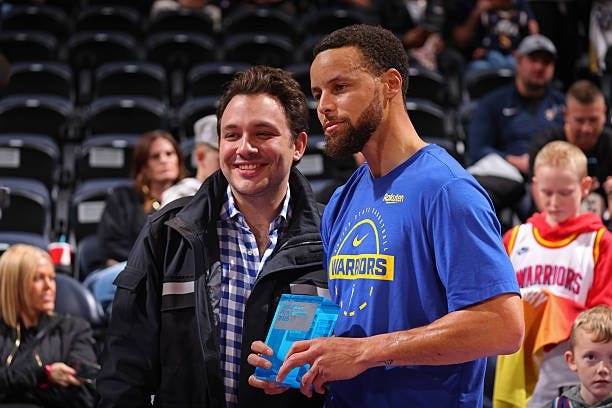
Steph was seen pregame courtside with the doc’s producer, two-time Oscar winner filmmaker Ben Proudfoot, who brought the blue-hued award with him (picture courtesy Getty Images):
Also in the embedded video at the top of this article is Moses Moody, who related the “crazy” and sudden circumstances of Jimmy Butler tearing his ACL to things that happen in life…
00:00 Moses, what do you think the biggest difference was tonight?
00:10 MOSES MOODY, POSTGAME GSW-UTA: I think we got everybody involved. It was a flow out there. We, it was like it was going from 20 to 10 to 20 to 10, so that last stretch, being able to rise it together and going that last round when we needed it was a big thing.
00:29 That first half you guys made 15 threes, seven twos, like, what was working for you guys offensively in the first half? What did you see from deep?
00:40 I think the driving and kicks was good. And then drive-kick one more, playing fast defense, turning into offense, all of that contributed to it.
00:54 Overall, being 2-2 trip, you guys finished with a win. What do you take away from the trip and getting four games under your belt without Jimmy?
01:02 Yes. We’re figuring it out and overnight the season changes, the team changes with Jimmy going out like that and it’s like any other process, you got to figure it out over time. And that’s the process that we in now, so I’m glad we able to get those wins under our belt and continue to figure it out.
01:23 Moses, do you feel like everybody’s kind of through the emotional part of it, of the injury and the aftermath?
01:32 Yeah, that’s the way that the NBA works. Crazy things happen every day. You gotta be able to move forward, not even just the NBA, that’s how life works. You gotta be able to read and react, change course and work with what you have now. And I think that’s where we at. That’s what we’re doing.
01:50 What does Al give to the starting lineup? How does his presence out there change that dynamic?
01:55 That’s a great way to ask that question. He has a lot of presence and that’s on the defensive side. On the offensive side, you feel when Al’s on the floor and that’s us on the offensive side and I feel like defense feels his presence as well. So he’s obviously gonna knock down the shot, so much on defense. He can get — he’s just a smart — he played the game for so long. He’s always got the right reads. He going to cut. He gonna slip when he need to. He’s always in the right spot, so he adds a lot.
02:26 That’s it. Cool. Thank you.
—
02:29 What’d you like tonight (inaudible)?
02:33 STEPH CURRY: I think overall just weathering the storm of our early turnovers and then we had some, it was like transition, we were throwing the ball all over the place, playing a little rushed, but then we settled in and when we got the ball moving, made them make rotations. Guys were just finding themselves open, especially from behind the arc. Mo had an unbelievable game. Everybody on the bench who came in contributed, extended leads, so it was obviously an effort, everybody showing up, but with 20 turnovers you can play better. But thankfully shots went in.
03:14 Utah’s big guns didn’t do much to contribute. Was that more of off nights or you guys having good team defense or both?
03:22 Usually in the league it’s a little bit of both. It is not a night where all good offense doesn’t beat good defense, but we’ve been playing at a high level on that end of the floor trying to rotate, be on a string. We know we’re usually undersized, so it requires a little bit of extra effort. And we’ve been doing that pretty well as of late, so you could have the same defense and guys hit shots and it’s a different narrative, but thankfully we were able to have an impact on that end of the floor.
03:58 (Al started.) You like that look?
04:01 Yeah, just because it, I mean, we all know the conversation of Draymond (Green) at the 5. QP (Quinten Post) had some looks, there. Al, knowing the back-to-back situation, but when he’s available, he gives us another presence defensively and he spaces the floor, unbelievable passer, so he’s kind of the full package, knowing it’s limited minutes, but he’s just such a presence and it helps. It helps Draymond on the defensive end. It helps us collectively on the offensive end, the plus-minus showed that tonight, so it’s good.
04:34 What does winning the Sundance award do for you?
04:39 Well, you do projects, not really looking for that type of acknowledgement. You do it about for the content, for the story that you’re trying to tell, but I was having a conversation with somebody. These type of awards only kind of further the opportunity to tell Clarence’s story. He’s 95 years old. He’s had such an impact on our country through his civil rights work, his speech writing, his legal work for Dr. King. And the fact that now we have a platform and opportunity from his own perspective, his own experience and his words, be able to tell his story in a documentary like that, so I know myself and the director, Ben Proudfoot, who worked on the project, they were ecstatic, but it’s not about us. It’s about him and his life’s work, so I’m happy to be a part of that team.
05:48 (Were you able to attend Sundance last night?)
05:49 I didn’t. I couldn’t make it there last night, but I went three years ago when we did the Underrated doc and did some screenings up there. I guess ironically it was the first time I’ve done an acceptance speech over WhatsApp video, so it was Ben was up there on stage and put the mic or put the phone next to the mic and I got to give a thiry-second speech, so I was there in spirit.
06:17 It’s been over 10 years since you had at Curry Camp and one of those campers was Ace Bailey. He went on to win MVP. What stood out to you about him then and then what is it like playing against him now, as he made that name for himself in the league?
06:34 You see the raw athleticism, but just the motor, the skillset. At camp, he was the dominant, present, or physical presence at all three levels of scoring. Defensively, he’s going all over the place and he stood out and then, to your point, he carried that. We always say we’re just a small stop on the next generation of talents’ journey to get to the league. And not every kid makes it, but somebody that is as talented as him, to be on this level, figuring it out on the fly, it’s fun to watch, fun to see. There’s a lot of Curry Camp alumni in the league now, which is pretty special, so I’m glad to still be around doing it and competing against those guys.
07:21 (Have you gotten an) existential bigger picture than you were early in the road trip?
07:25 Not really. I think our job is to keep winning games and keeping our energy as high as we can around here. We’re not ignorant to what’s going on around the league, rumors and trade talks and who’s on the block and all that type of stuff, so I know what’s going on, but right now it’s just about trying to continue to win because if we lose sight of that on the court, all that other stuff doesn’t really matter.
07:59 (Inaudible) not necessarily this player or that player, but an approach (inaudible)?
08:05 We’ve always had a expectation, myself, Draymond, just knowing the conversations we’re having all the time. I don’t ever get into hypotheticals. It’s a waste of time. It’s a waste of energy. It’s not my job to do that. Mike (Dunleavy, Jr.) is, and the entire front office, I’m sure, making calls. I’m sure taking looks, seeing what’s going on and then if there’s something material, something real, we have conversations about it and decisions are made, so that’s our process. It’s always been that way. I’m assuming it’s gonna be that same way over the next week and a half, but when stuff happens, you’ll know.
08:50 Steph, through the years how often (inaudible)?
08:56 Every off-season. Every lead up to the trade deadline, whether something happens or not, again, there’s a trust that exists in the communication. It started with Bob (Myers), it’s transitioned to Mike. Doesn’t mean every conversation goes the way I want it to. Doesn’t mean they get the feedback that they want, but it’s collaborative. And again, it’s not my job to make those decisions, but you want to be in a team and a culture that, again, I know if there’s something material, they’re gonna run it by me and if it’s not, I don’t necessarily need to know what’s going on.
🫶💙💛