

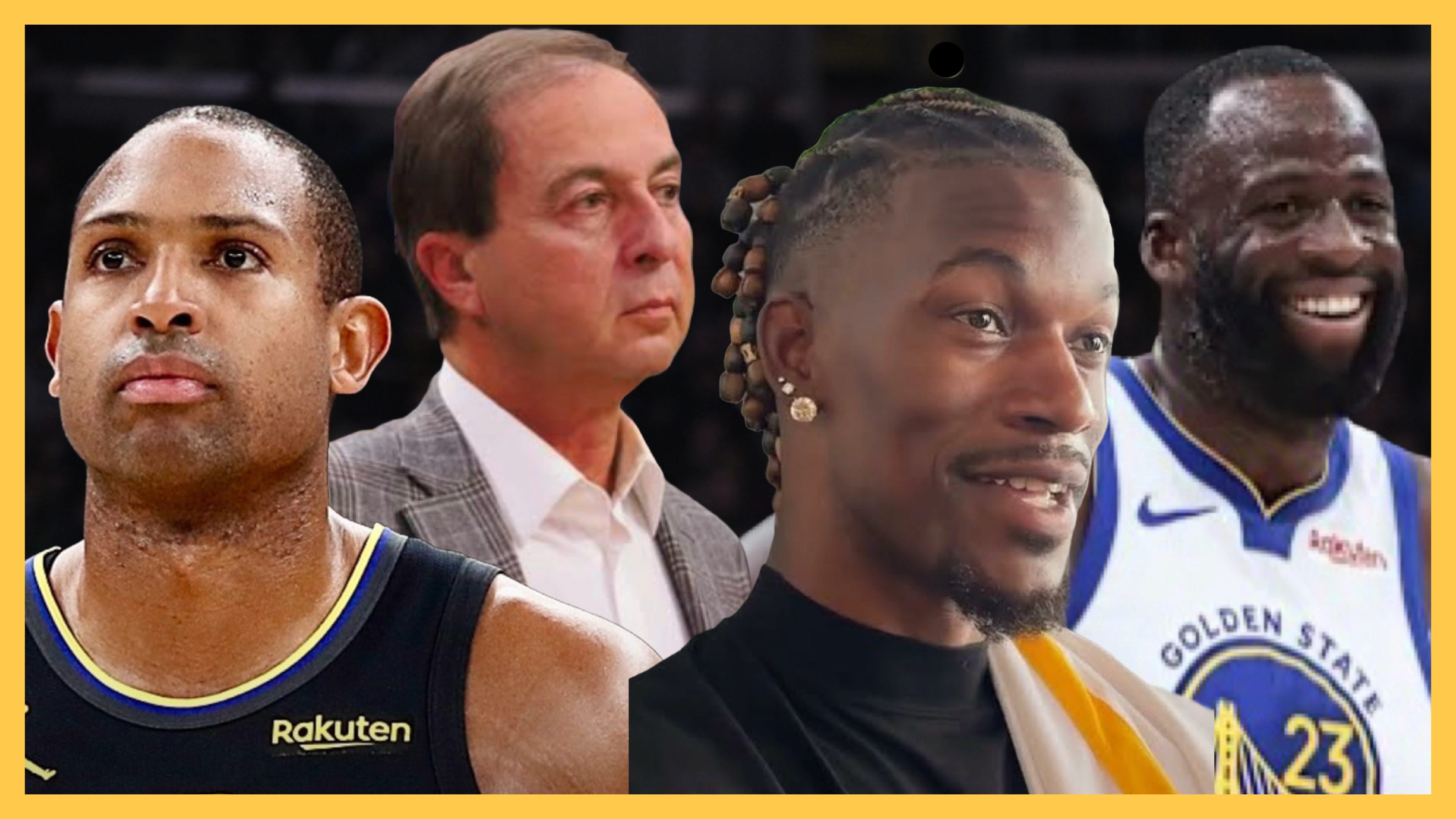
One of the reasons I enjoy building salary cap spreadsheets is that they force me to think like an NBA front office. Fans naturally ask, “Should we trade for this player?” or “Should we sign that player?”
A front office asks a different question: What possibilities does this move create — or eliminate?
That distinction became very clear on Thursday. The morning began with the news that Al Horford had agreed to return to the Warriors on a reported two-year, $14 million contract.
By itself, that didn’t dramatically alter my cap sheet. Horford’s deal fits neatly into the range of the 2025-26 taxpayer mid-level, the mechanism by which Horford joined Golden State, that I had already been projecting.
The bigger surprise came several hours later: Jimmy Butler appeared alongside Joe Lacob during the Warriors’ introduction of IREN as the franchise’s new jersey patch sponsor. Obviously, that wasn’t a basketball transaction, but I think it mattered.
Over the past several weeks, I’ve built dozens of Warriors salary-cap scenarios. One of my favorite — not because I expected it to happen, but because it solved so many mathematical problems — was trading Butler for Kawhi Leonard.
The appeal wasn’t Kawhi himself. The appeal was what the trade unlocked.
Specifically, the Dubs would be sending out Jimmy and Brandin Podziemski as well as two first-round picks (2027 and 2032) for Leonard. In fact, this was first proposed at the end of the regular season by ESPN’s Aaron Snellings.
Because Jimmy’s salary is already $6 million more than Kawhi’s and Podziemski makes about $5 million, the combined $11 million savings represented a jump start towards ducking under the luxury tax line.
Then, by having Draymond Green opt-out and sign an extension at a lower average annual value, plus massaging the number for Kristaps Porziņģis, you could theoretically get under the luxury tax line and enable the Non-Taxpayer Mid-Level Exception (NTMLE), which is roughly $15 million.
I’ve always understood how unlikely that trade was. Steve Ballmer has consistently been reported as wanting to keep Kawhi, and there has never been meaningful reporting that the Clippers were shopping him.
But if the dominoes fell, an entirely different decision tree opened. The Warriors could:
stay below the tax,
gain access to the NTMLE to go out and sign a free agent for roughly $15 million (this is the mechanism by which a lot of presumptuous speculation has been made by reporters),
retain De’Anthony Melton for roughly $13 million while remaining below the first apron,
and potentially execute a sign-and-trade involving Porziņģis at a competitive salary (as high as $24 million, depending on the discount Green would give – in this case, down to $16 million), perhaps enough to dissuade LeBron James from staying with the Lakers, who have a lot of cap space.
That wasn’t really a Kawhi story. It was an optionality story. The Kawhi trade simply opened the most doors.
Then Thursday happened. Seeing Jimmy next to Joe changed how I think about that branch:
Could the Warriors still trade Jimmy this summer? Of course. Nothing in the collective bargaining agreement prevents it, but organizations send signals. Introducing your brand-new jersey patch sponsor with Jimmy sitting beside your owner sends one.
From a business standpoint, it would create awkward optics to feature Jimmy as part of the franchise’s public face only to move him a couple weeks later when free agency begins. That doesn’t make a trade impossible, though, especially in a world where Luka Dončić got traded.
It just makes me think the probability dropped dramatically. The Kawhi branch of the decision tree suddenly looks much smaller.
Maybe it isn’t gone forever. Maybe it simply gets postponed until February. Cue the Jaylen Brown trade scenarios — which, indeed, we have talked about, especially towards the end of our Pr-Draft Livestream Special back on Monday, June 22:
Why does this IREN sponsor event matter? Because once Jimmy stays, the Warriors lose their cleanest path toward getting below the luxury tax. That also means the NTMLE becomes extraordinarily difficult to access.
And it was this morning when Bobby Marks of ESPN finally blessed my conclusion, saying:
Because of the first apron hard cap, it is unlikely Golden State can use the $15 million non-tax midlevel exception and still have flexibility to remain under once the roster is filled out.
However, I have a feeling that little paragraph still might get glossed over. We’ll see, because dutifully, Marks made a list of potential free agents that might fit the Warriors after that paragraph and those might get taken out context if the assumption is via the NTMLE.
I’ve seen plenty of discussion suggesting the Warriors can simply use the NTMLE. The spreadsheet says otherwise.
To reach that point, you’d essentially have to renounce Porziņģis—or ask both Kristaps and Draymond to accept discounts that I simply don’t believe are realistic (KP to roughly $12 million and Dray to $17 million).
This was shown step-by-step here on my last video:
That’s asking KP to slash his market value while simultaneously asking Draymond to take a massive pay cut.
Possible? Technically. Likely? Not in my opinion.
This is where I think fans and salary-cap mechanics often diverge. Many discussions begin with: “Do we even want Porziņģis back?” That’s almost the wrong question.
The better question is: “Do you want to preserve a $20-plus million salary slot?” Because once you renounce Porziņģis, that slot disappears.
Now you’re shopping with exceptions instead of contracts. That’s a very different toolbox. Keeping KP isn’t necessarily about keeping KP forever. It’s about preserving optionality.
Only a couple more days to go! Everything now circles back to June 29. Draymond’s player option has become the biggest remaining domino. If he simply opts in, most of the Warriors’ offseason becomes fairly straightforward:
Re-sign Porziņģis, operate above the tax,
use the Taxpayer Mid-Level Exception (TPMLE), and
keep building from there.
If Draymond instead opts out and signs a longer extension with a smaller first-year cap hit, suddenly new branches reopen. That’s where names like LeBron become mathematically interesting.
Not because LeBron would sign for the TPMLE (roughly $6 million). He almost certainly wouldn’t. Instead, the conversation shifts toward a sign-and-trade involving Porziņģis, but even there, the first apron becomes the limiting factor.
The Warriors can’t simply absorb any salary they want. Everything has to fit.
As I worked through Thursday’s livestreams, three names kept resurfacing:
Bron — If Draymond accepted a lower first-year salary, the Lakers might have interest in Porziņģis as a frontcourt piece alongside Doncic, giving the Warriors a plausible sign-and-trade framework.
DeMar DeRozan — Unlike LeBron, DeRozan could potentially be acquired more directly through a Porziņģis trade if Sacramento viewed Kristaps as a better roster fit. Credit our long-time YouTube commenter Robby Bautista for this idea. I think I would rather keep KP, though.
Anfernee Simons — While the Dubs do have a glaring need for a ball-handler who can get downhill and get a bucket, this one becomes much harder. It’s not enough for the Warriors to want Simons. Chicago would also have to decide that receiving Porziņģis in a sign-and-trade is preferable to every other offer available around the league. That’s a much tougher sell.
Collin Sexton — Sexton ironically ended up a teammate of Simons on the Bulls at the February trade deadline. Simons has made more money in his career, but the Warriors might prefer Sexton’s better defense. Again, it all depends on if the Bulls have better sign-and-trade offers than Porzingis.
That’s ultimately what Thursday taught me. One piece of information quietly eliminated one of the cleanest pathways through the Warriors’ cap sheet: Jimmy isn’t getting traded this off-season.
The decision tree became smaller. Now, almost every remaining branch runs through June 29. We’ll know much more once Draymond “makes his decision”, although I would be shocked if he and Mike Dunleavy, Jr. have not worked through their own spreadsheets as I have. Until I am presented with evidence otherwise, I am of the firm belief that opt-ins or opt-outs are usually mutually agreed upon to a certain extent.
And so the math — not the rumors — should be leading the conversation.
The NTMLE needs to be tweeted about with caution, my friends!
Below the paywall 👇 is my projected cap sheet for 1) if Draymond opts in, or 2) if Draymond opts out — as well as a couple tidbits on Quinten Post, Charles Bassey and Pat Spencer.
🫶💙💛
