

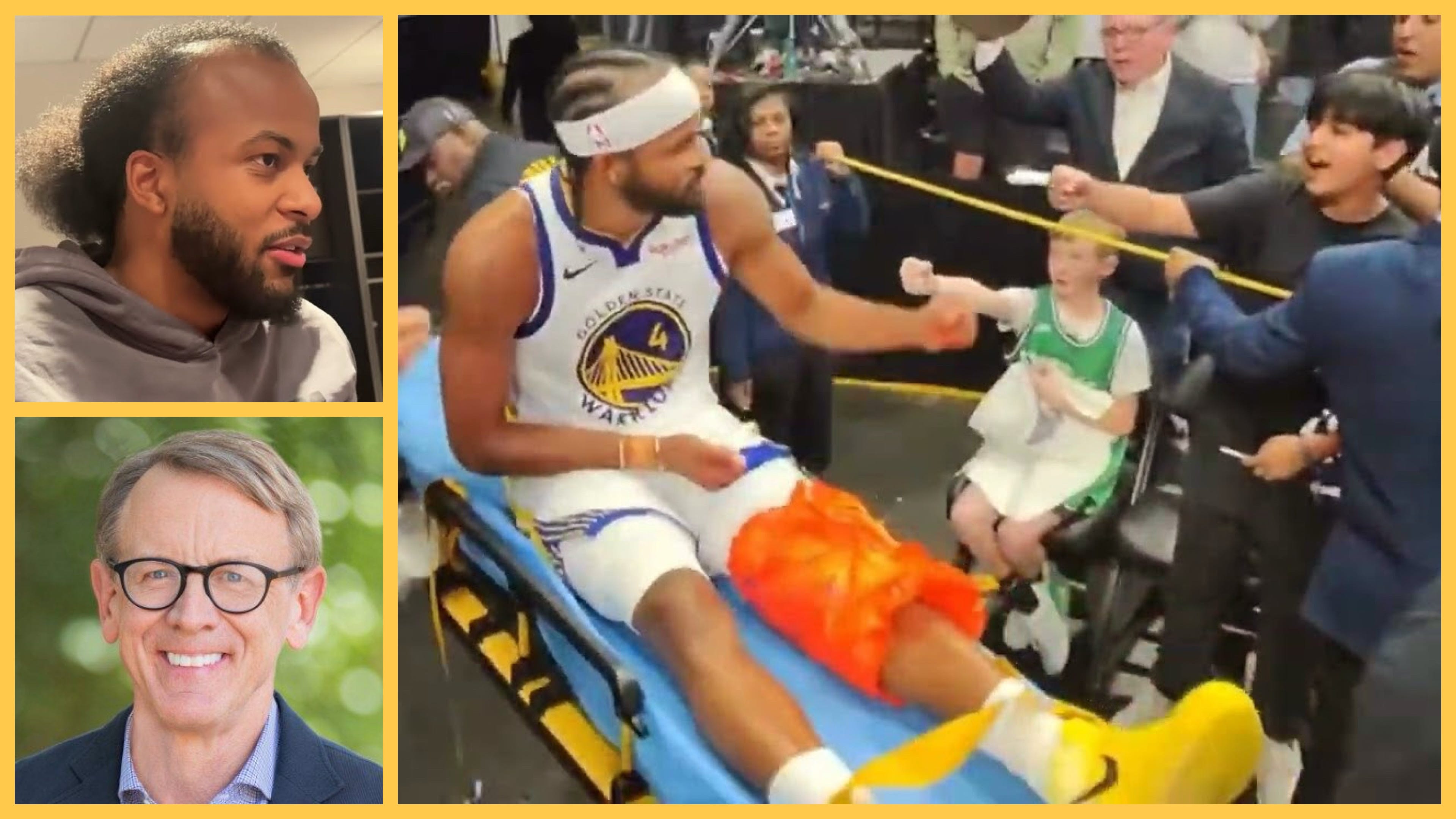
Good news, Moses Moody did not feel any pain when he tore his left patellar tendon in Dallas back on March 23rd (see full transcript below). And he said in Sacramento the other night that he had been dealing with patellar tendon issues since middle school:
My knees been bothering me for a while, like from middle school to high school and it’s all been patellar tendon, so I’m glad to finally get it fixed.
For his rehab, he dropped a pretty impressive name:
I don’t have a target right now. I just kind of put my head down and do the work and we’ll get there when we do. I’ve been thinking about setting some goals. I’ve been talking to my man John Doerr about OKRs and just the way to set goals and track them, track progress and figure out a plan then for success.
Back in my previous life, even before running men’s basketball leagues, my friend Paul Hsu — whom I met through hoops, thanks to a mutual family friend — helped get me a job at PricewaterhouseCoopers in the Emerging Company Services group (PwC-ECS), a very small handful of non-accountant business development staff who would help Silicon Valley entrepreneurs connect the dots with lawyers and venture capitalists.
Back in the dot-com era, the Big Three of VCs were Doerr of Kleiner, Perkins, Caufield and Byers (KPCB), Bob Kagle of Benchmark Capital and Michael Moritz of Sequoia Capital, in reverse order of whom PwC-ECS had the best relationships.
OKRs stand for Objectives and Key Results, a methodology of “stretch goals” inspired by Silicon Valley legend Andy Grove of Intel, that Doerr brought to Google and Amazon. One of the most important things venture capitalists do is help grow companies from small teams surrounding the founders and scale them to global businesses, so OKRs became a tool for forming corporate culture.
Obviously, Warriors owner Joe Lacob works for Doerr’s legendary firm, KPCB, but did you know that Marissa Kagle, Bob’s wife, has been reported as serving on Golden State’s executive board, as the Kagles are minority investors in the team? She is often courtside a ways towards halfcourt from Joe and his wife, Nicole Lacob.
Perhaps not coincidentally, Moritz, who has retreated since 2012 from leading Sequoia due to health concerns, is the founder of the SF Standard, which of course has Danny Emerman reporting from Warriors games and, on occasion, feature writer Tim Kawakami.
The GSW are still represented by Sequoia in a big way, though. Mark Stevens also left the firm in 2012, but currently sits on the Executive Board of the Warriors as a minority owner. He was the partner that led Sequoia’s 1993 investment in Nvidia. Incidentally, Moritz famously has never sold a single share since.
So, Moody calling Doerr “my man”, that’s actually pretty big if you ask anyone down by Sand Hill Road.
But Moses has been continually making connections over there. He even recently created an AI version of himself:
Below is his transcript from postgame af the Warriors lost to the Kings:
00:00 Come get him now and you guys will get him back when he returns to practice sometime next season.
00:07 How have you kind of processed all the time since the injury and the surgery and everything that’s happened in between?
00:12 MOSES MOODY, POSTGAME GSW-SAC: Yeah, it’s been good just going through the processes, the stuff that we gotta do.
00:19 What is, I guess, for you the next step of rehab at this point?
00:23 Over time, we just getting more — bending it more and we have to strengthen the quad, activate the quad and all of that (inaudible).
00:33 How are you feeling?
00:35 Yeah, I feel good. It’s a unique time in my life just being able to kind of slow down. Being in NBA season, you ripping and running, doing so much, traveling so much, so being able to slow down, sit down, have a routine, get better at some stuff, it’s been cool. Talk to my family, talk to a lot of people on the phone all the time now, so yeah, just being intentional with my time is just something I’ve been focusing on and that’s been, I’ve enjoyed it.
01:02 How has it been to be around the team, this last week or so?
01:05 Yeah, it’s been cool because I’ve been away, obviously, with the surgery and the first week of rehab and all of that, so just coming back and being able to be back in the locker room, feel like a player again, be — yeah, be on the sideline, come to Chase, get the love that I got. I appreciated that a lot. That was big for me, just being able to feel it in the arena. It was — I really enjoyed it.
01:29 Kinda, I guess, you getting the surgery, I’m sure talking to a bunch of people, experts on the injury, where’s just your conference level that obviously you’re gonna miss probably a chunk of next season, but then you can kind of just resume your career?
01:42 Yeah, yeah. I’m good. I like talking to the doctor, talking to some players that’s been through it. I like what everybody’s saying and yeah, I’m confident it’ll be a good situation.
01:54 Any specific players that you were talking to?
01:58 Well, I was talking to Kelenna.
01:59 Yeah, for sure.
02:00 And talked about, like, because our injuries happened in a different way and everything, so just kind of comparing, contrast notes and, but — yeah. Yeah.
02:12 What kind of information did the doctors tell you about the recovery timeline and what will be required to recover successfully?
02:19 Yeah. Well, they told me I — for a patella tendon tear, this is the best-case scenario being straight from the bone or clear tear, so if it’s not, the tendon-to-tendon and that’s harder to make it heal and be stronger, but being from the bone, they can connect it to the bone and that’s just a better way to do it, so that was good news and then the surgery was, they said it was pretty easy. I was under maybe like 90 minutes. It wasn’t too bad, yeah. And then I was doing rehab the next day, so on my way back.
02:52 Are you, I mean, do you have any target in your mind, date-wise? Are you thinking about next season?
02:58 Yeah, I don’t have a target right now. I just kind of put my head down and do the work and we’ll get there when we do. I’ve been thinking about setting some goals. I’ve been talking to my man John Doerr about OKRs and just the way to set goals and track them, track progress and figure out a plan then for success.
03:18 Is there any advice you’re kind of taking to heart as you head into this rehab process? You said you talked to some of the players and other players and everything.
03:24 Can you say that first part again?
03:27 Is there any advice that you’re kind of taking to heart as you kind of approach this rehab process?
03:31 Yeah, my knees been bothering me for a while, like from middle school to high school, so — and it’s all been patellar tendon, so I’m glad to finally get it fixed. So, and then coming back, I think I would be able to be in a better place than I was when I left because of it and then slowing down and training movement patterns and a lot of the stuff that I’ve wanted to have the time to do, the recovery process, like that’ll be that, but then after I’m recovered, being able to really train my body and my movements in a way that I want to. I’m excited for that.
04:04 Moses, can you kind of just take us through the play that it happened on and did you instantly know something was wrong?
04:11 No, I didn’t. It didn’t hurt when it happened, so when I was going on a fast break, I thought Cooper ran from the backside and I thought we just bumped knees a little bit or something and then going back and look at it, he was nowhere near me, so I felt that, but when I looked at it is when I knew that it was something, I didn’t know what it was, but it was something, but I thought it was maybe dislocated or something and they could pop it back in and I’ll be all right, but yeah. So yeah, it was — yeah.
04:43 How many times have you watched the play?
04:45 Well, I’m not big on social media a lot and I know it’s been everywhere, so I mean, but I haven’t watched it that many times. I’ve seen it, but not a lot.
04:55 You, I mean, how do you view your season and how well you were playing? I mean, even the night that it happened, how well you were playing in that game and where you’re at your career up to that point?
05:04 Yeah, proud of it. I like the game we were having. That was the first game back from the wrist thing and it was a good game to be coming back. It was fun being out there and just the journey of my career has been a fun one and I’m at a good point, just getting better and better statistically and physically every year, so glad to continue that, figure some stuff out.
05:33 (Inaudible) feeling the fans’ energy? Have you felt like guys have felt more energy here on the team?
05:38 Oh yeah. I’m curious. You gotta ask them. I would hope —
05:43 You seem pretty optimistic. Is that a fair way to say how you’re feeling right now?
05:49 What you mean by optimistic?
05:51 Attacking glass half full, maybe? Just feeling positive and everything.
05:55 Yeah, I feel good. Sometimes you talk about optimism, it’s like a — I don’t know, but I have a — I feel good about the future. I see a clear path and just following that, I think is the task.
🫶💙💛