

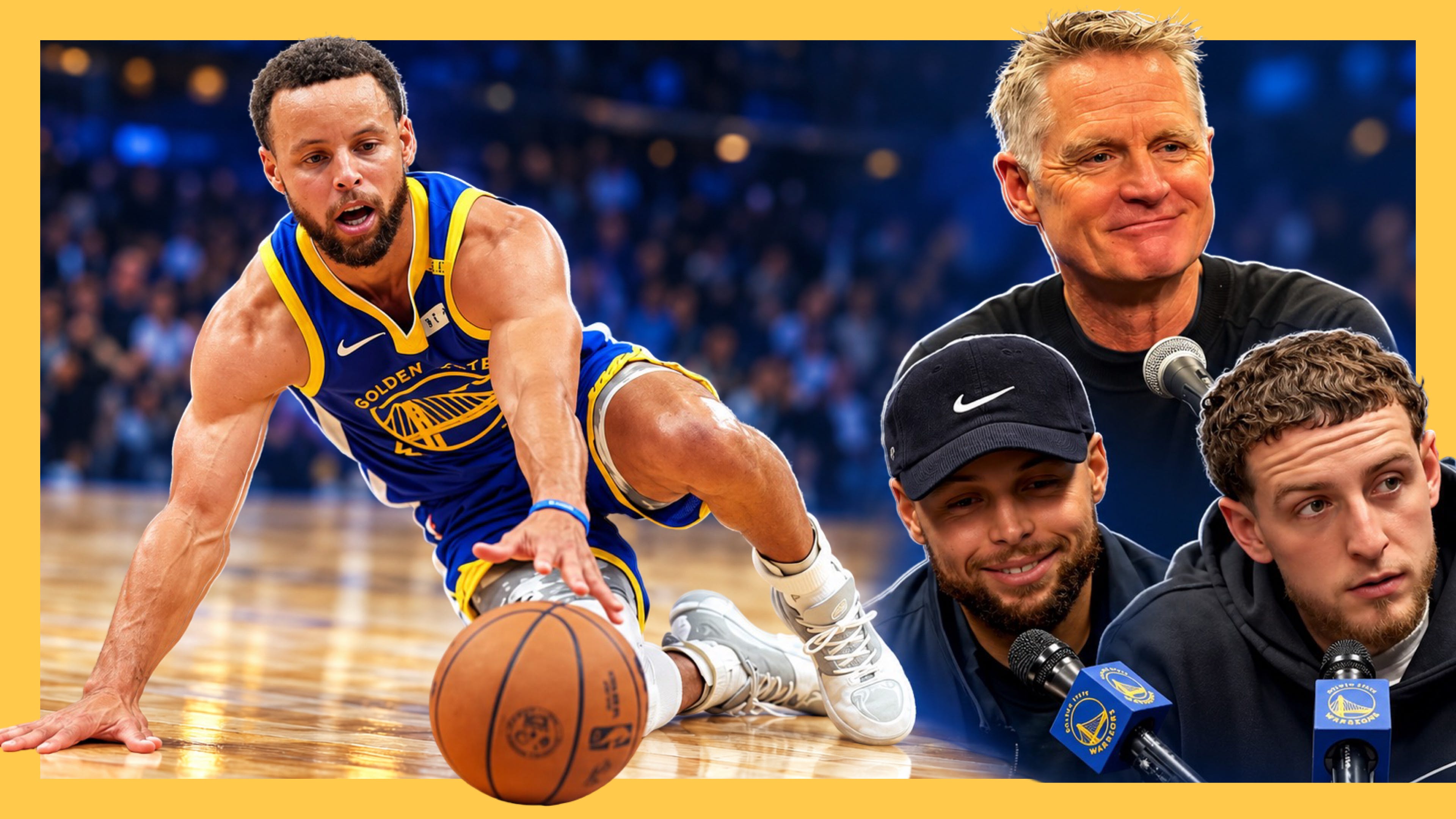
One Wardell Stephen Curry II scored 44 points in Minnesota, but I finished the game wondering whether he should have played fewer minutes.
That sounds strange until you watch the possessions that nearly turned a comfortable Warriors win into another painful loss. Draymond Green bobbled a pass. Steph missed opportunities he had been converting earlier. The ball pressure became harder to handle. It sure looked like some uncles out there.
Steph got picked by Ayo Dosunmu with 24 seconds left, Warriors up four, but De’Anthony Melton got back and blocked Dosunmu at the rim, helping Golden State escape, 119-114 — oh wait, actually, Draymond threw the rebound to the other team, then Jaden McDaniels missed not one, not two, but three threes in a span of ten seconds, then after the buzzer Steph got to do his old pregame dap with Jonathan Kuminga who, thankfully, was a near-non-factor this game. 😅
Earlier, in the third quarter, Curry chased a long rebound, struggled to catch up to it and slid out of bounds. Watching live, I recognized something familiar from the latter stages of my own playing days: knowing where you want to go and discovering that getting there, the body doesn’t always respond to the brain.
Of course, Steph told us otherwise. He framed it as the opposite, an indication that he still has the gumption to go get the ball at this advanced age and early portion of the season — although I think we can all agree that he’s not quite in tip-top shape yet (will he ever be, though? We just don’t know with that runners’ knee):
I think that’s just more indicative of how good I feel considering the age, the miles and how last year went, that I even tried it and had a confidence I could get down there and, to your point, I love — I mean, there’s situations that you’re gonna find yourself in where you’re just playing basketball and reacting and not thinking about anything and that’s one of them.
[NOTE: Per usual, entire transcripts behind the paywall, below 👇]
So yeah, I’d almost rather he not try to chase that one down because it kinda wasn’t close. Bottom line: he could not and did not catch up to that rolling ball.
That play alone doesn’t tell us how many minutes Steph should play. Neither does a bobbled pass. But those moments were eyebrow-raising and the closing stretch made the question harder to dismiss.
When my sometimes co-host Bruce Maro joined our postgame livestream, he helped turn those observations into a broader discussion about what this Warriors team needs from its veterans and what it should start asking of everyone else.
Is 32 the new 36?
Bruce came in with a provocative assessment: he saw the younger players as a strength and the veterans as a potential weakness.
I wanted to sharpen that immediately. The concern was the veterans playing extended minutes — which can become a glaring weakness. Steph had just scored 44, in 32 minutes played, his first past that 30-minute goal that Steve Kerr has alluded to since training camp started (and in years past, has been the 32-minute mark).
Curry’s ability to take over a game was right there in front of us. What we were discussing was how much energy he and Draymond had left for the finish. Is 32 minutes becoming the new 36 — or even 38 — for Steph?
In other words, before last season you’d like to not have him reach 36 or 38 minutes, but if that won you the game, so be it.
So, we kicked around a workload closer to 28 minutes — and if he had to go to 32 for the win like on Wednesday night in Minneapolis, so be it. Therefore the target should no longer be 32, or even pared down to 30. It should be decreased beyond that to, say, 28.
But would that kind of adjustment require Steph’s own buy-in? There isn’t a magic number we established on the livestream, but I think the Warriors should be examining whether their familiar expectations for a normal night still fit what these players are being asked to do.
The game demands repeated changes of direction, recovery efforts and decisions against pressure. We’ve already talked about breaking old habits. Being capable of an extraordinary scoring night doesn’t necessarily mean every additional minute carries the same value. Bruce then brought up Denver. Had Steph and Draymond needed to finish that game?
We checked the box score: Steph had played 27 minutes. The Warriors had maintained their advantage without needing his final rotation. That comparison made me more concerned about what we had just watched in Minnesota.
This wasn’t a finish immediately following a marathon outing in Denver. There had been an opportunity to conserve some energy, yet several possessions still looked labored. It also showed us a possibility worth pursuing: build a lead, trust other players to sustain it and let Steph finish the night with something left.
Who gets those minutes in the meat of the game, as Steph likes to say? This is where Bruce’s contribution helped move the conversation forward. If we think Steph and Draymond should play less, we have to identify who can handle more.
Brandon Williams gave the Warriors 11 points and zero turnovers (!) in 14 minutes. There were drives when his change of speed jumped off the screen. He could go from surveying the floor to attacking a gap in a flash, especially on a night when some of the veterans’ possessions became slow and difficult.
I wanted to see a few more minutes for him. Bruce added a useful qualification: the matchup matters. Against Minnesota, he liked the opportunity. Against a player such as Luka Doncic or Austin Reaves (coming up tomorrow), who can manipulate a defenders and bait him into mistakes, he was less certain. Williams earning more responsibility in one matchup doesn’t mean every opponent presents the same assignment.
Still, he was playing well in this game. Could the Warriors have used that performance to buy Steph a little more rest?
Reducing Draymond’s workload requires its own answer. Williams can take on backcourt responsibility; he doesn’t replace what Draymond does in the frontcourt. That brought us to Charles Bassey.
Viewers raised the question of trusting the other bigs and I specifically wanted more than the two minutes Bassey received. Bruce agreed with the larger point: this team has useful players beyond its biggest names. Having depth becomes meaningful when the coach uses it.
My concern with Kerr is the tendency for certain players to fall out of the circle of trust. Then the veterans absorb the responsibility again and we find ourselves asking why they look worn down late.
Those additional minutes don’t all have to come in the final two minutes. An earlier stint can change how much a veteran has in reserve when the game reaches that point. That is the rotation question I want the Warriors to explore.
When did the game actually turn?
Kerr’s explanation afterward gave Bruce and me another point to debate. Steve traced the trouble to the third quarter, with Golden State ahead 73-50:
So, the NBA game today, the game's changed so quickly. And that's why, yeah, they picked up their ball pressure in the fourth, but we let them off the hook when we were up 73–50 with all those turnovers. Then the whole game changed right then, at that point. That's when it got wild and crazy. Up to that point, I think we had five turnovers in the first half and we were probably still right around five. And instead of staying in our offense and with our execution, we got wild. And once the game changes in the NBA, it is hard to get it back. And so we've got to learn the lesson. But the effort was great. The connection, the guys' energy, everything was really good. I'm really excited about this team. But we've got a lot of growth ahead of us.
His assessment was that the Warriors sensed an opportunity to blow the game open and started chasing spectacular plays instead of making solid ones. The ensuing turnovers when they were up, 73-50 (by Yaxel Lendeborg twice, and Steph and Draymond once each, by the way) changed the game, and Minnesota’s increased ball pressure made it harder to regain control.
I understood the explanation. Watching live, though, I was more bothered by what happened later. The Warriors still had opportunities to settle down in the fourth quarter. Instead, there were possessions when Curry seemed to be looking for the knockout three.
There was the dribble toward the halfcourt corner that ended with Georges Niang saving a precarious possession before a timeout. There were missed opportunities around the rim and the bobble by Draymond before Steph’s near-airball.
That leaves a few explanations to examine: Were they physically tired? Had they become too casual with the lead? Were they responding poorly to the pressure? And how much did their own shot selection make the remaining work harder?
Those questions overlap. A rushed possession can give an opponent another chance to run. A turnover can require another recovery effort. A lead that should have allowed someone to sit becomes a reason to send him back out there.
This is why I want to look at the actual sequences. The loose-ball chase, the bobble and the late decisions aren’t interchangeable evidence. Some raise a physical question. Others raise a question about execution. The Warriors need to make these finishes less demanding on Steph and Draymond.
The team takes its cue from Curry
Bruce pushed the discussion further by arguing that the team takes on the identity of its best player. His criticism of Steph’s approach was sharper than mine. He thought the Warriors had started behaving as though the game was already won and that Curry’s choices helped set that tone.
I brought up joy. So much of what makes Steph special comes from the freedom and delight with which he plays. The celebrations, the audacity, the shots that make everyone else shake their heads, that is part of the experience of watching him.
I also brought up examples of Steph being very deliberate about execution. We have seen him decide that protecting the ball and controlling the game are the priorities. The middle of the Houston seven-game series and Boston Game 4 come to mind.
Where Bruce and I found common ground was in the possessions themselves. With a substantial lead and plenty of time remaining, there were moments when simply running the offense looked like the better choice. Of course, it would have been nice to have one more high-IQ slip-cutter like Gui Santos (knee) out there for said execution, so fully healthy maybe we’re alright.
But an opponent making a three doesn’t require an immediate three in response. A chance to deliver a spectacular finish doesn’t require taking it. Steph’s decisions carry extra weight because everyone else is reading him. If he stays patient, keeps the ball moving and continues doing what built the lead, that gives the team a clear example to follow.
Bruce’s argument also connected back to the minutes discussion: maintain that discipline while the lead is large, and perhaps Steph doesn’t have to do so much work at the end. That is a possibility worth taking seriously.
A win worth learning from
Bruce admitted he had penciled in Denver and Minnesota as losses. Coming out of those games with two wins improved his outlook on the team. Mine has reasons for encouragement, too. The Warriors got themselves to 2-3. They have players capable of contributing and we saw enough good basketball to understand how they built those leads.
That makes this a useful moment to examine the workload. Steph can still produce a night like this. Draymond can still make important defensive plays and organize the offense. The question is how Golden State distributes the work around them so those contributions remain effective through the finish.
This is one reason I appreciate Bruce hopping onto the livestream. I had the plays in my notes and a strong reaction to what I had seen. He brought his own assessment, prompted the Denver comparison and qualified the Williams discussion by matchup. We didn’t agree on every explanation and the conversation was better for it.
If you missed it, our closing-possession breakdown begins at 02:47:18, Bruce joins at 02:58:21, and we return to Kerr’s explanation and Steph’s influence on the team at 03:40:29 — also, recap is in the description:
My takeaway is that the Warriors have enough promising alternatives to start testing this now. Give Williams more responsibility when the matchup supports it. Find meaningful opportunities for Bassey to contribute. Keep executing when the lead is comfortable enough to create some rest.
Steph gave them 44. I’d like to see whether a little more help along the way could leave him with a little more for the finish.
But then again, Curry has to accept this as fate, now, and — that’s a hard habit to break. 😬 🤷🏻♂️
So we might have to see a couple slip-ups-turned-losses before there is meaningful attention to what looked to me like something familiar in my past: watching some over-the-hill OGs try to keep up with youngsters in any random men’s league here in the Bay.
Or Bruce and I could just be wrong and Steph and Dray will soon get into shape, nothing to worry about.
Below the paywall 👇 you’ll find the full written transcripts of the postgame interviews, so you can read the complete questions and answers and revisit the comments discussed above. Thank you to our paid subscribers for supporting this coverage.
🫶💙💛
