

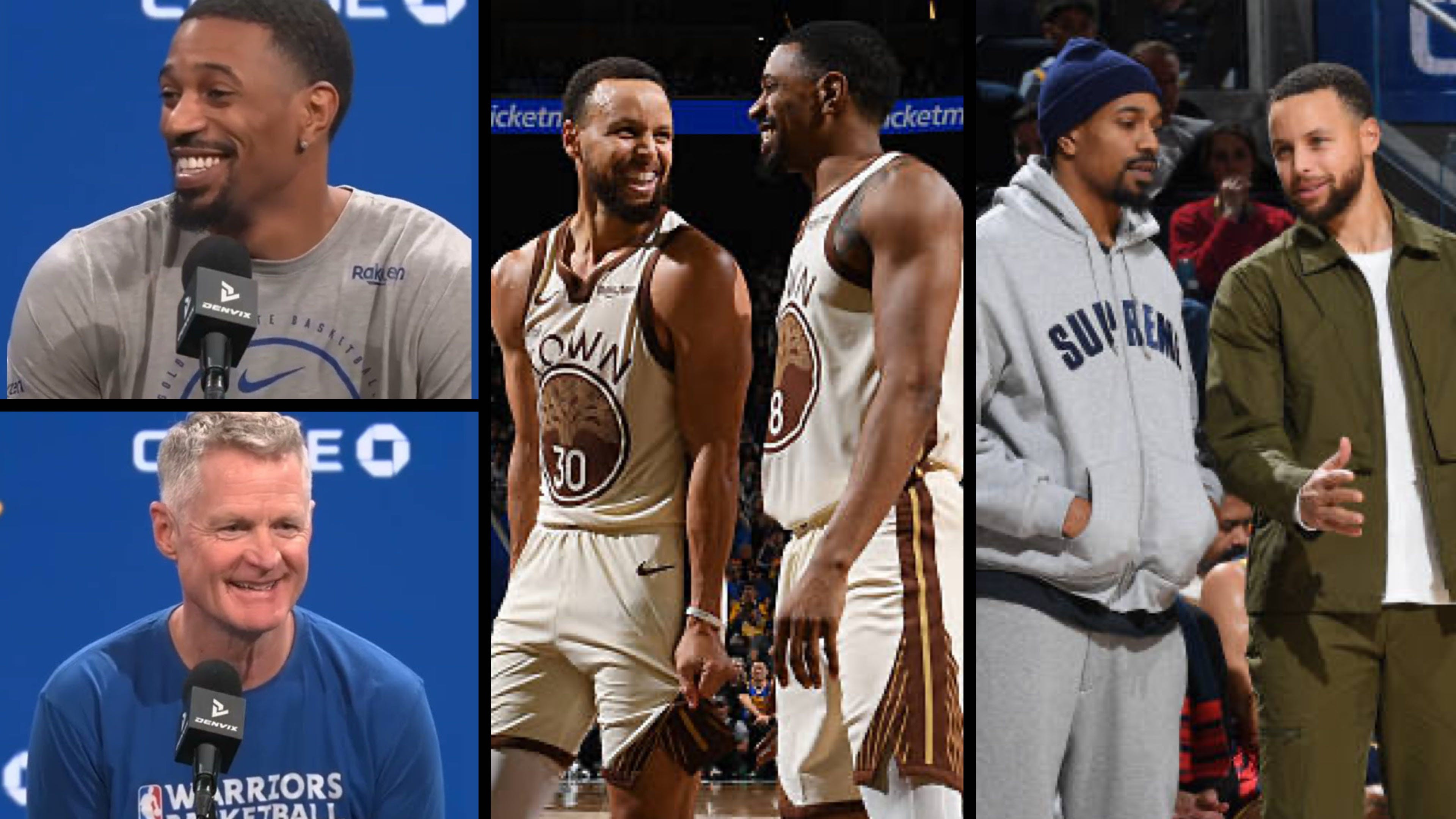
After practice the day after the Milwaukee win and before the Sacramento game, De’Anthony Melton gave a crash course on how to play with one Wardell Stephen Curry:
His ability just to keep playing, keep the music singing, run around screen, catch. Double come out, he throws it right over the top, throws it right away, pin or wave (off). If he doesn’t feel like it’s right there, he’ll tell you just to go flash or do this or do that. And it’s just so quick and it’s just so on-the-move type of feels.
And you can see the defense just get frustrated with some of the stuff he does, because you could see three people jump out on a pin-down on him that now you’re wide open getting layups. Not so many people on any other team has that ability that can shift the whole defense just by coming off a pin-down without even having the ball. So that type of stuff, you gotta just take advantage of and just be aggressive with.
It took me awhile to decipher what Melton had said about the “pin-or-wave”. In fact, in the captions I initially wrote “pin-away”.
I might be wrong — and I’ve asked someone who would probably know, but that person hasn’t answered back yet — but I’m thinking it’s the action where Curry is off the ball and so is another player, Melton in this case.
In this terminology, Melt is looking at Steph to see what he should do: set a “pin-down” screen for Steph to come off of, or get waved off by Steph so that something else can be created on-the-fly, such as maybe him going the opposite way towards the ball for a hand-off, let’s say.
“Pin-or-wave.” Hopefully, that’s what Melton said. Hit me in the comments if I’m wrong.
It reminds of way back, December 28, 2018, to be exact, when I asked Chris DeMarco what a DHO meant after Draymond Green mentioned it in a scrum.
Seven years later, it’s part of the NBA lexicon these days, primarily because other teams started stealing the Warriors’ “dribble-handoff” action after all this time. It’s now a staple of most teams’ actions and players often refer to those in interviews.
But the “pin-or-wave” is so unique to Curry. We are likely not to hear that uttered too much, at least not to the frequency of “DHOs”.
Want more?
Here’s Melt going in-depth on how the Warriors’ ecosystem, along with the added flavor of Jimmy Butler, differs from just about any other team out there — full transcript below, along with Steve Kerr from practice before him:
A lot of teams, they don’t move as much, you know what I mean? They have set plays that they get into and they have set schemes that they shelter their team to, but on this team, we have a guy that likes to run around and move around more and not be in one specific spot.
And then you got another dude with Draymond who’s, if you’re open, he’s gonna pass it. And if he sees an opening, he’s gonna try it. And nothing is set in stone.
And then you got Steph and Dray. They have their own plays that they run in-between games and people don’t even notice, but they think it’s a set.
And then Jimmy’s just so strategic on how he wants to attack the game and how he sees it. And it’s just high-level IQ players all around that.
You can’t script everything. You can’t be like, okay, you go here, you have to do this and sometimes it just happens differently. And sometimes dudes want you to think on the fly and I think that’s what this team does. It just helps you think on the fly and understand what needs to be done, just to put the ball in the basket or get the win.
Obviously, this stuff as well as Gui Santos on the podium last week — maybe I’ll cover that on here soon — can be viewed as an indictment on Jonathan Kuminga and the inability to find a fit for him in this ecosystem, but I think we need to show some grace and mindfulness and remember that what Melton described is more the exception than the rule.
But more on that some other time…
00:00 De’Anthony, having played for a little more than a month now, how do you just feel physically?
00:11 DE’ANTHONY MELTON, PRACTICE, DAY BEFORE SAC-GSW: Man, just to hear it, playing for over a month, I’m excited about. But I’m feeling well, taking it game by game. I think adjusting to different teams, different coverages and different players is, that’s just what I’m trying to get more acclimated with.
00:28 Last night was your first 20-point game since December 27th, 2023, but it was only your 25th game since then, also, too. How do you wrap your mind around that? And what has been the mental stages of that, too, as far as the injuries and coming back and getting your footing now?
00:48 Just to hear that kind of stuff is just crazy to even think about, honestly, but I’m just so blessed. I’m just so blessed just to be in this position I am today, you know what I mean? That to have the team around me that I have and just to be able to just still lace them up is always important for me, just taking, like I said, just keep taking it day by day, taking it game by game. I think before I was, I’m trying to sum up everything in my next game or my next play, so now I’m just just trying to be more free about stuff and just cut myself some grace, too.
01:23 De’Anthony, how do you play free or how do you get past that mindset that you had? Was there anything that you did in particular?
01:32 Having conversations with people help, people telling me that give myself grace. I think I wanted it so bad and I just wanted to be productive and especially win games so bad that I was putting it all on me. And I think I had to sit back and understand that, like I said, it’s a lot of adjusting that’s happened, sitting out 12 months, 13 months in the NBA and coming back to play isn’t easy. And some of these guys and some of these teams I haven’t been playing against in two years, I just gotta take it day by.
02:07 Can you share a little bit more of the mental side because that’s an injury and a surgery that forces you to pause your career and you are back, you are an NBA player at a high level? You have to trust your body at this point, but that rehab where you can see how far you’ve come, but how far you still have yet to go, it’s--
02:26 Exactly.
02:27 It’s a mind trip. What was that like?
02:30 Man, like you said, every day it was just like progress and then the next thought is how much more I still have to do,? Like you said, mentally it was tough especially after sitting the year before that pretty much, with my back, something catastrophic like this happening. It just put everything in perspective and I had a lot of time to think and I had a lot of time to be by myself. It was good and it was bad at the same time with certain situations, but ultimately it was just about pushing through, seeing the light at the end of the tunnel and understanding that eventually you’re gonna be okay. And I had one of the best doctors in the country work on my knee and then him telling me it was one of his best surgeries and everything like that, that definitely put a little shining light on my situation, too, because nobody wants to have to go back in for something else or have to go back for something else. I think I had a great team around me, Elite Ortho Sport, the rehab that I got sent to. They did an amazing job for me, just keeping me right, keeping me ahead. And then getting back here, the confidence I have in them. I knew they could get me back to where I needed to be and they’ve had guys deal with stuff like this and played at a high level still. So I just wanted to be one of those.
03:54 After surgery, did you get the little handicap pass for your car? No, no, really, did you see like accessibility stuff? Did you see that — ?
04:03 No. Where I get that at, though?
04:05 Oh!
04:06 Where I get it at? I need one.
04:08 No, you can’t get it now.
04:09 I can’t get it no more?
04:10 No, but right after surgery, well — so I’m not a professional athlete, but I had ACL and I do remember trying, you get the little handicap pass for your car, so you — and you learn that it is not an accessible world for people on crutches or wheelchairs or any of that kind of stuff.
04:27 Nah, but that first month to two month of moving around, it’s, yeah, it really is real tough, getting in and out the car. Luckily my uncle, he lives with me, so he definitely helped me and he was taking me to all my physical therapy appointments, but yeah, just having to get through and get in the car and then not bump your leg on the way out and all that stuff is definitely annoying.
04:56 Do you like the way that your scar healed?
04:58 I do and everybody tells me it’s a good looking scar, so I’ll take it another scar on my body, why not?
05:06 De’Anthony, what’s the biggest difference between learning how to play within this system and playing in any other system around the league?
05:17 I think just with any team you gotta adjust to your star players. I think sometimes people get wrapped up in worrying about other things and everything like that, but at the end of the day these dudes make these type of money to do certain things in this league and they’re very good and they’re very elite at it. The superstars we have on this team, they’re just selfless. They’re willing to give up that open shot. Jimmy had a pretty easy lay layup and he still, he kicked it out to me for a three. In his head, sometimes I may need that open shot, then he’s made a whole bunch of layups all his career, so him seeing me have one go through the basket, I think is very important. And that type of stuff is just what they do, always making the extra pass, always making sure other guys are feeling good and understanding that, as a team, when everybody else is feeling good, then you know they’re gonna be feeling good. So they’re always gonna get their numbers. They’re always gonna get theirs, but when other guys are rolling, too, we’re a dominant team out there.
06:24 To a lot of what you just said, why do you think you have fit in so well here?
06:31 I fit anywhere, honestly. I feel like I can adjust to however anybody plays. Kind of like going back to what I was saying, understanding what your team needs are with your team superstars adjust to you. Last year or two years ago when I was in Philly, how Joel (Embiid) plays, more of a slow style, catch the ball at certain spots and everything like that. And I still feel like I played pretty well there, but you gotta adjust to whoever is on your team and on your roster, so I think these guys, they can score the ball in so many different ways and everything like that. I just gotta find a way to just be aggressive and just play my game and I feel I can adjust to anybody.
07:11 What is the key to you in being an effective point-of-attack defender?
07:16 Learning dude’s tendencies, understanding who I’m going against my matchup, seeing what they like to do, how they like to get they shots and just nagging at the ball. A lot of dudes in this league, they’re very good at what they do. Some of these dudes in this league, they can’t really dribble all that well. Being a constant pest sometimes is where it’s at and not getting blown by, but at the same time heating up the ball and making somebody do something they don’t really like to do, or breaking the offense, this type of stuff that is beneficial for our team.
07:53 Just to follow on that, how do you feel defensively right now?
07:57 I feel pretty good. I think that’s one the last things they said was gonna come back for me, from my ACL. But I think more so it’s just getting back used to guarding these quick fast dudes and quick change-of-pace guards and shifty and, especially now, you can’t touch a decent amount of them. So trying to stay out of foul trouble, I feel like I’ve been fouling crazy, you feel me? But yeah, just staying disciplined. I think that’s the biggest thing, staying disciplined. Effort. Defense is a lot of just having effort, wanting to do it and wanting to be out there and wanting to stay in between your man in a basket and you just gotta, just want to do it.
08:41 And during your time off, either with your back or with the ACL, did you find any outlets or hobbies that really did help you mentally? Obviously you were left out on basketball, but it’s good to have that outlet as well.
08:53 I would say I played a lot of video games. I love playing the game. I still play the game. I watched a lot of shows. I watched a lot of shows. I ran through a decent amount of Netflix shows, Prime shows, HBO Max shows. I’m watching Sopranos right now and then reading. I read a decent amount, too, which was good. Got to read the Power of Now, 48 Laws of Power. But yeah, I think those type of things was major for me. And sleep. I got to sleep a lot, so that was also good, too.
09:31 Hello, Melton, from your time working with Stephen Curry, did you notice any qualities that the great shooter needs to have?
09:41 Man, discipline and a regimen. Steph does the same thing almost every time he steps on a court. He has a purpose. I think that’s the biggest thing, having a purpose and being confident. He has such a good thing where he just, he misses a shot, he just wipes it. And he just — and he moves on, so I think that’s something that a lot of people can have as a shooter, just having that keen ability just to understand how you missed and just move on to the next shot and just have the ultimate next confidence in your next shot.
10:16 And talking about playing the different basketball system when you’re playing the Warriors, their system, did you feel like the flow and rhythm or the ball moving is quite maybe a little different with when you play with a different team?
10:31 Oh, most definitely. The shots and the passes you get on this team is a lot different from what you get on other teams, honestly, because it’s just the randomness of the team and the randomness of the — sometimes the offense. And that’s the beauty of it. You can catch a lot of teams off-guard with it, just the way you pass, cut, move and just being a threat. So other teams you have a script or more so, but on this team it’s just pass, move, cut, screen away, screen, find the open guy and just keep the ball moving.
11:06 What make this different?
11:09 A lot of teams, I’m — a lot of teams don’t move like that. I don’t know, yeah. A lot of teams, they just don’t — they don’t move as much, you know what I mean? They have set plays that they get into and they have set schemes that they shelter their team to, but on this team it’s just, we have a guy that likes to run around and move around more and not be in one specific spot. And then you got another dude with Draymond who’s, if you’re open, he’s gonna pass it. And if he sees an opening, he’s gonna try it. And nothing is set in stone. And then you got Steph and Dray. They got — they have their own plays that they run in-between games and people don’t even notice, but they think it’s a set. And then Jimmy, he — Jimmy’s just so strategic on how he wants to attack the game and how he sees it. And it’s just high-level IQ players all around that. You can’t script everything. You can’t be like, okay, you go here, you have to do this and sometimes it just happens differently. And sometimes dudes want you to think on the fly and I think that’s what this team does. It just helps you think on the fly and understand what needs to be done, just to put the ball in the basket or get the win.
12:19 De’Anthony, you just touched on this, but earlier you said how a team plays is linked so much to its stars. And Joel in Philly and Steph seems particularly unique in the way he plays. And you just referenced it, but how would you describe, not just playing with Steph, but being his back court partner, which you started with him for a while last year? You’re closing with him now. What’s that like and how unique to every other basketball player on the planet is that?
12:47 His ability to shoot the ball is no other. And I think just being on his team more so, it’s just seeing his ability to get downhill and get to the basket. And I feel like he’s finishing well this year, just taking contact and not getting the calls always that he wants, but he’s still finishing through and he’s still figuring it out how to get the ball in the basket and just, he’s just, his ability just to keep playing, keep the music singing, run around screen, catch. Double come out, he throws it right over the top, throws it right away, pin or wave (off). If he doesn’t feel like it’s right there, he’ll tell you just to go, flash or do this or do that. And it’s just so quick and it’s just so on-the-move type of feels. And you can see the defense just get frustrated with some of the stuff he does because you could see three people jump out on a pin-down on him that now you’re wide open getting layups. So I don’t think — not so many people on any other team has that ability that can shift the whole defense just by coming off a pin-down without even having the ball. So that type of stuff, you gotta just take advantage of — take advantage of and just be aggressive with.
14:01 And do you recall for so many years he had the same back court partner in Klay. And it seemed like such a good fit, size-wise. Klay was obviously very good defensively to take some pressure off Steph. What do you recall watching them play together and did you ever think, “Hey, I can do — I could be a good fit with Steph”?
14:19 I don’t think I ever thought that them two wouldn’t be on the court together, honestly. So now to see it now, just you gotta learn from stuff like that, learn from how well they played together, what made Steph great, what made Klay great and just try to implement that into your game. I think my jump shooting ability is well and is just getting better, too. And also defensively, just the point-of-attack defender, just having somebody to help out and also talking to Steph, telling him what I see on the court defensively. Sometimes it’s, “I need you just to show, I don’t need you to be around the ball, I just need you to stab and I’ll get back,” and just keep him away from certain matchups to preserve his energy, you know what I mean? That’s the most important thing. I’ve seen a lot of film, minutes of them two together, so just understanding what the — what that takes and success that it can be.
15:19 Postgame, Steve got a question about whether he would consider putting you in the starting lineup and he pumped the brakes on it, saying he hasn’t even played 30 minutes a game. There’s still that ramp up, but should you reach that point where Rick Celebrini says, “Yeah, he can go,” is being a starter something that you would hope for?
15:35 Oh, for sure. I think starting this league is what everybody should hope for, honestly. I’m willing to do whatever the team takes. And like you said, just that ramp-up stage is most important for me because I wanna make sure I’m accessible and available for this team when we’re in May and going into the month after that, and everything like that. I’m not trying to be too worried about January. I feel like that’s what was hindering my play in December, worrying about so much of the full season instead of just taking it game by game and seeing where that goes.
16:12 Cool. Gotta think of a name, maybe the Slush Brothers?
00:00 STEVE KERR, PRACTICE, DAY BEFORE SAC-GSW: Hi guys. Braves fan, Joe (Dycus)?
00:02 I’m a big Braves fan.
00:03 Are you from there, from Atlanta?
00:04 Close. Pretty close. They’re the local team, so it was a tough year. But I guess, so what was the focus of practice today and what were you guys hoping to achieve?
00:17 It was a walkthrough day, mostly rest, a little bit of prep for Sacramento tomorrow, some of the things they do. And then film from last night, just things we want to clean up and continue to emphasize.
00:35 How much was there really to clean up after last night?
00:40 Obviously, we did a lot of good things. Late game, I didn’t think we executed that well offensively, so we’re still trying to get better with our offensive execution, but the process, as I said the other day, process has been really good the last couple weeks. We’re winning the possession battle, crashing, taking care of the ball, getting good shots, defending pretty well, so we’re trending in a good direction.
01:10 In the rotation last night, it seemed pretty easy for you to slot Gui into Gary’s minutes. They don’t look the same as players, but how similarly do you view their roles and their status within the rotation?
01:25 Yeah, they’re different players, but they make a similar impact. It’s energy, it’s ball movement. They’re two of our best swing passers. We get an advantage, the ball gets to either Gary or Gui, it’s gonna be swung and it’s gonna be a good pass, rhythm, on target, on time. Gui had one last night, he could have taken the shot and he found Steph for a wide-open three. It may look routine, but it’s not and I would say that Gui and Gary are two of our very best making that play. They both make Steph better. They both understand how to play with Steph. It’s obviously a really important thing to do on our team.
02:15 Steve, Steph called De’Anthony a prototypical shooting guard last night. What is a prototypical shooting guard in the modern NBA, in your eyes?
02:25 Somebody who can make plays. I think it’s a playmaking league now, positionless, multiple guys who can dribble, pass, shoot. And that’s Melt. He’s a two-way player, excellent defender, but when he’s out there, I can have him handle the ball, I can have him play off the ball. You see the shooting is starting to come around and it’s fun to see him really finding his groove after missing most of two years.
02:57 Following up on your earlier comment about GP playing with Steph and we talked about that for a couple years how good they are together, what about GP makes him such a good fit, that makes them so productive together and how much does their bond — they have a bit of a history and friendship together — does that matter at all?
03:18 Some of it is what I just talked about. The swing pass is understanding how to get Steph the ball. Some of it is Gary’s our best screen and diver, finisher around the rim, and he does it with such speed and explosiveness. And he frequently has a big guy on him. A lot of teams put their center on him. The way he races into the screen, he creates a lot of separation and then, after screening, he dives into the pocket and he’s great finishing. He’s also great at finding weak-side shooters, so a great pick-and-roll player. And so when he’s out there, we tend to put him in pick-and-roll with Steph and we create a lot of advantages. He’s a great defender, on-ball. He’s one of the best in the league. He’s unorthodox. He’s a 6’3” power forward who guards point guards. That’s weird. The reason it’s worked here is, he’s found this great connection with Steph, with Draymond. He understands how we play. He’s got a really good feel for the game and, yeah, he’s been a winning player here since the day we got him.
04:37 Do you recall anyone else in your long basketball journey who even remotely resembled a 6’3” power forward?
04:44 That’s a great question. I’d have to give it some thought, but it would take a while to find someone. He’s a very unique player and, honestly, it’s one of the reasons he had a hard time finding a home in the NBA and he bounced around and played in the G League and played on 10-days. He’s just a — he’s not the prototypical NBA player. He’s a unique guy, but he found his home here because it just clicked with us.
05:15 Very different than 6’3” shooting guard Steve Kerr, huh?
05:19 Yeah, I would say quite different player, yeah.
05:24 Oh, hello Coach. Yesterday, about Moses yesterday, you said he’s someone who doesn’t get too high or too low. How much do you think this trait really matters in his career?
05:36 Yeah, I think Moses has a great approach. I could tell when he was a rookie, he was very quiet, but when he would speak, there was a lot of wisdom. And got great parents, Kareem and Rona, we know very well. They come to a lot of games. They’ve lived here in town and been part of a lot of events and when you see Moses and then you meet his parents, it all makes sense. He’s a product of his upbringing, just the poise and the wisdom. And I love coaching Mo. He’s just a really good teammate and he’s very consistent for us with his on-ball defense and he doesn’t turn the ball over. He’s a really good, solid player.
06:27 What do you think about this chapter of the season, so to speak, to have an eight-game home stand? And then Draymond was in the hallway yesterday post game saying, “We can’t win eight until we win the first one,” but it seems like you guys have talked about this.
06:38 He said, we can’t what?
06:39 “Can’t win eight unless we win the first one.”
06:41 Oh yeah.
06:43 Okay.
06:44 True.
06:45 True, but what is it about this chapter of the season that could be very important for you guys as you try to go up the standings?
06:51 We’re pretty healthy. We have Al and Melt healthy and in a pretty good groove. That’s how we envisioned our team in the beginning of the season. Maybe it’s fair to say, this is the first time all year that we’ve seen our team like this, where we feel whole and it happens to come during or in the beginning of an eight-game home stand. It all lines up really well, so we just have to follow through and if we have a great home stand and we stay healthy and we stay with the process that we’ve been on the last couple weeks, we have a chance to be the team that we envisioned at the beginning of the year.
07:47 What is your assessment of the point-of-attack defense this season and how has Melton contributed in that regard?
07:53 Melt’s one of our best on-ball defenders. Melt, Moses, Gary, those guys are all really good on-ball defenders. Melt just seems to move differently than most players on the floor. He’s so smooth and quick and strong and so it’s really fun to see him contain the ball and not allow penetration and, overall, our defense has been really good. We’re Top Five and we’ve been there the last month or so for a reason. We’ve got a lot of brains with Jimmy and Draymond kind of anchoring things and our defensive coaches have done a good job putting together a good plan and we’re sticking to the plan pretty well. So it’s exciting.
08:46 Steve, to follow up on Melton, how quickly did you guys know — and I say this in context of several guys last night were, like, “He just knows how to play. He knows what we do.” How quickly did you guys see that he just fit here and understood what he needed to do?
09:03 We saw it last year for six, seven games and then he got hurt. And it was such a shame because we saw it instantly and it’s how it works, really. You can see generally with guys pretty quickly whether they really have a good feel and whether they’re skilled enough to dribble, pass, and shoot and make decisions. And you could see it right away with Melt. Thanks guys. See you tomorrow.
🫶💙💛