

UPDATE — October 10, 2026:
Brandin Podziemski has now agreed to a five-year, $110 million extension with the Warriors.
The cap-sheet analysis below was written and published before the agreement. At the time, I modeled a hypothetical five-year, $100 million contract to see whether Golden State could make a major long-term commitment to Podziemski while still preserving its Summer 2027 optionality.
The actual deal came in $10 million higher.
What makes today’s news especially interesting, though, is that the central question remains the same: not simply how large the headline number is, but how the contract is structured — particularly in Year 1 — and what that structure means for the Warriors’ 2027 cap sheet.
Rather than rewrite the original analysis with hindsight, I’m leaving it intact below so you can see the exercise as it was originally worked through.
Saturday night, I opened up our Summer 2027 Warriors cap sheet on YouTube with what sounded like a pretty simple question:
How do you get Brandin Podziemski to a number that feels good enough for him and his camp without messing up all of the optionality Golden State has worked so hard to create for next summer?
By the end of the exercise, I think we found a pretty compelling answer. Also, somewhat counterintuitively, five years might actually work better than four.
$20 million per year just has a ring to it, not because I have been told that Podziemski is asking for exactly $20 million (I have not), but when you look at the market around him, it feels like a reasonable neighborhood to explore. More importantly, it gives us a round number from which we can start building an actual contract rather than just throwing opinions around about whether Podz is “worth” this much or that much.
Ayo Dosunmu just received five years and $112 million from Minnesota, or $22.4 million per year, with a player option in the fifth season. Peyton Watson received four years and $88 million from Cleveland in his sign-and-trade, or $22 million per year, also with a player option, plus a trade kicker.
Those are the two contracts I care about most when trying to establish the current neighborhood for Podziemski. Dosunmu is another combo guard who can start or come off the bench and just played extremely well in the postseason, while Watson is longer and more defensively versatile, but landed in roughly the same financial range, not to mention he was also a non-Lottery first-rounder in the same Draft as Podziemski, at No. 30 to the Denver Nuggets, of course. Both Dosunmu and Watson came in above $20 million per year.
I am deliberately not anchoring this exercise to Christian Braun’s five-year, $125 million contract. That deal was signed under a different market context, before another season of information came in, also on the heels of a seven-game Western Conference Finals ouster against the Minnesota Timberwolves, when Denver was still legitimately considered title contenders, just one year after their 2024 championship.
I view Dosunmu and Watson as much more useful present-day markers for this negotiation, so if Podz and his representation look at those contracts and say, “We belong somewhere in this general neighborhood,” I don’t think that would be particularly surprising.
The more interesting question is whether the Warriors can get there without sacrificing Summer 2027.
That is where this gets fun. I share the details below the paywall in written form, but if you don’t mind the answers in video form (with timestamps), check out the live:
If you enjoy this kind of Warriors cap-sheet work — working through what Golden State can realistically do before the move actually happens — consider subscribing to Let’s Go Warriors.
Paid subscriptions help support our independent Warriors coverage, livestreams, film study and deeper roster/cap analysis.
Now, back to the original exercise…
Podziemski currently projects to carry a cap hold of approximately $17.038 million in the summer of 2027 if the Warriors simply let him reach restricted free agency without an extension. That number matters enormously.
Golden State has spent a lot of time creating a cleaner 2027 cap sheet and in the version I have been modeling, the entire objective is to preserve the ability to go shopping for another major player while one Wardell Stephen Curry II is still here, rather than inadvertently eating away at that room with contracts signed a year earlier.
Spoiler: Making some reasonable assumptions about the optionality on Kristaps Porzingis’ non-guaranteed second year and the trending market for over-35 players like Jimmy Butler and Draymond Green, I’m relatively comfortable declaring that a max free agent slot of $61.9 million is very doable, even with Curry pegged at the $55.7 million for 2027-28 he just signed:
The Max Slot Survived Steph Curry’s Extension on 2027 Cap Sheet

I went into Friday’s livestream planning to make an argument I’ve made in this space before: that one Wardell Stephen Curry II should probably wait to sign an extension, if the goal was to give Golden State the most flexibility possible entering the summer of 2027.
And yes, as of this writing, Karl-Anthony Towns still does not have an extension signed with the New York Knicks and long-time beatwriter Ian Begley just wrote that the two sides are far apart. I’m still thinking KAT when I see the max slot on the Warriors’ 2027-28 mock cap sheet and I’ll write more about this in due time.
Capsheets.com currently lists Podziemski’s 2027-28 cap hold at $17,038,375, with a projected $176 million salary cap, so my first instinct was pretty straightforward:
If we think BP ultimately lands around $20 million annually anyway, can we somehow make his first-year salary look more like that $17 million cap hold?
The answer is yes.
The 5-year/$100 million version
This is where Bird Rights become our friend. Because Podziemski would be extending with his own team, the Warriors can structure the contract using raises of as much as eight percent of the first-year salary.
And this is an important distinction that I actually corrected in real-time during the livestream: those raises do not compound at 8% every season. Instead, the maximum annual increase is always 8% of the salary in Year 1.
The NBA’s own CBA explainer gives the easy example: if Year 1 is $10 million, an 8% raise is $800,000 every year, producing salaries of $10M, $10.8M, $11.6M and $12.4M — not $10M, then 8% of $10.8M, then 8% of the next number, and so forth.
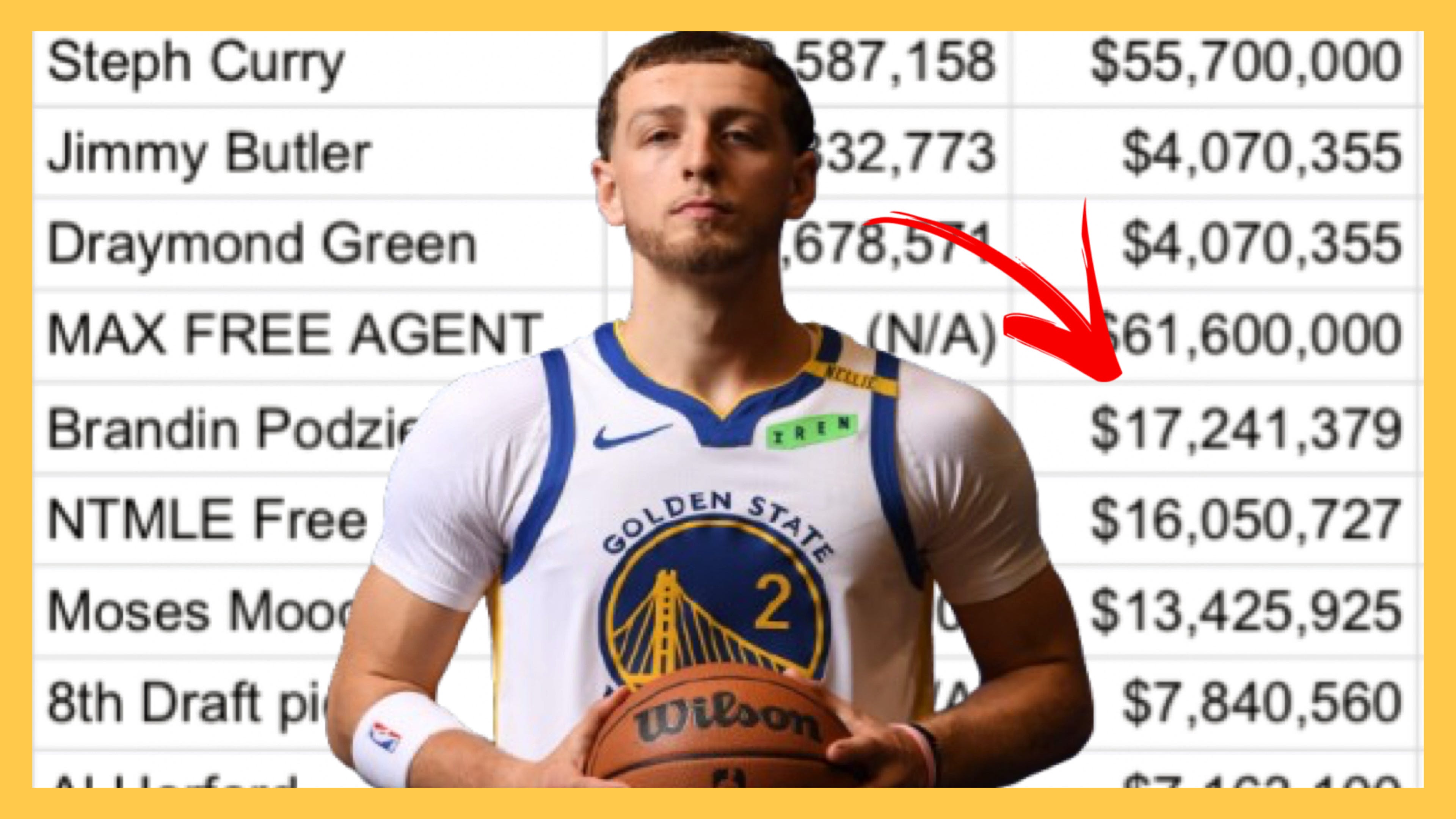
That distinction is what makes the Podz math so interesting. If you want a five-year contract to total exactly $100 million while using the maximum 8% raises, the first season only needs to be $17,241,379 (!). 👀
Then the contract progresses like this:
2027-28: $17.241M
2028-29: $18.621M
2029-30: $20.000M
2030-31: $21.379M
2031-32: $22.759M
TOTAL: $100 million
AAV: $20 million
That $17.241 million first-year salary is only about $203,000 more than Podziemski’s projected $17.038 million cap hold — just two hundred and three thousand dollars!
On a $176 million salary cap.
In other words, if my goal is to protect the Summer 2027 cap sheet, the difference between carrying Podz into free agency at his cap hold and already having him locked into a five-year, $100 million extension could be almost negligible.
That was the “aha” moment for me. We spent a good portion of the live actually building this out on the spreadsheet, right down to fixing the formulas so that the five salaries added up correctly to $100 million. Once we got there, the broader concept became pretty obvious: $20 million AAV does not necessarily mean putting $20 million onto the 2027 cap sheet.
4 years works too, but 5 is actually better
Then we tested the other obvious version. What if Podz doesn’t want five years? What if four years at the same $20 million average makes more sense?
Four years, $80 million with the same maximum raises looks like this:
2027-28: $17.857M
2028-29: $19.286M
2029-30: $20.714M
2030-31: $22.143M
TOTAL: $80 million
AAV: $20 million
Incidentally, we ran a poll and because I started the livestream pretty late at night, we only got ten votes, perhaps too small a sample size, but the bottom line is that 40% of the vote said Podziemski would be happy with $80 million over four years:
That’s perfectly workable, too, but notice what happened. His first-year salary went up.
The $80M/4Y version starts at about $17.86 million, while the $100M/5Y version starts at about $17.24 million.
By giving Podz the extra season and the extra $20 million in total contract value, Golden State actually saves roughly $616,000 on the 2027-28 cap sheet.
That’s not some franchise-changing difference by itself and I said as much during the live, but when you’re building a cap sheet where every $500,000 or $1 million can become useful around the margins, it is hardly meaningless either.
More importantly, the fifth year gives you something potentially valuable in the negotiation: the words “$100 million.”
The psychological component
Again, I have no idea what number Podziemski personally has in his head, and I don’t want to pretend that I do, but there is obviously a psychological difference between saying somebody received an $80 million contract and saying that player received a nine-figure contract.
Podz was the No. 19 pick in the 2023 Draft. If Golden State’s pitch eventually became something along the lines of, “We believe in you enough to give you five years and $100 million,” while the tradeoff was that the first season starts a little lower so the organization can preserve its ability to add talent around him, Steph and everybody else, I can at least understand how both sides could walk away feeling like they accomplished something.
Dosunmu is an interesting example here in his own right. He was the No. 38 pick and just secured $112 million, with the fifth season controlled by him through a player option. His deal escalates from about $19.31 million in Year 1 to roughly $25.49 million in Year 5.
Brandin at $100M/5Y would still come in $12 million below Ayo in total value and $2.4 million lower in average annual value. That feels like a useful negotiating reference point without suggesting that they are identical players.
And then there is the option question.
Team or player option? Fully guaranteed?
This is where the negotiation gets more interesting than the spreadsheet. From Golden State’s perspective, I would obviously love a team option on that fifth year. That comes in handy for optionality, precisely why Jonathan Kuminga’s second year was a team option, although we are talking about trade-ability of Brandin’s contract for the Summer of 2031 in this case for the Warriors. We might be splitting hairs and maybe that’s why the Wolves were okay with that final year player option for Ayo.
If Podziemski becomes significantly better than the contract, you pick it up. If circumstances change, the Warriors retain another layer of optionality. If he becomes a fringe All-Star-caliber player before then, maybe both sides eventually revisit the arrangement anyway.
But from Podz’s side, that is exactly why you would probably push back. Dosunmu got a player option. Watson got a player option. And if Golden State tells Podz, “Congratulations, you’re getting $100 million,” while Year 5 is actually a $22.76 million team option, his representation could fairly respond that he isn’t really being guaranteed $100 million at all.
The first four years of our five-year structure total only about $77.24 million, so if that fifth year belongs to Golden State, we need to be intellectually honest about what the contract really is.
Maybe the compromise is five fully guaranteed years. Maybe Podz gets the fifth-year player option. Maybe Golden State gets some other concession.
A player option isn’t all that bad. It allows the player to opt-out and construct a further extension, potentially baking in some of that final year into future out years, security and longevity versus abruptly reaching free agency again — this is what Draymond did this past summer in concert with the LeBron James pursuit, although that scenario never came to fruition.
I don’t know what Podziemski’s agent, the legendary Bill Duffy, and Mike Dunleavy, Jr. will ultimately be discussing behind closed doors, assuming negotiations get that far, but by the time you are haggling over who controls Year 5, you have probably already solved the much larger question: approximately how much money Podziemski is going to receive.
And $20 million AAV continues to look like a very interesting middle ground to me.
Why the 2027 optionality matters most
This is the part I think gets lost when fans react to contract totals. Five years, $100 million sounds enormous, but NBA contracts don’t exist in a vacuum. The timing of the salary matters, the percentage of the cap matters, what else is on your books matters and what the cap sheet allows you to do next matters.
My Summer 2027 model remains exactly that: a model, not a prediction. It assumes some pretty aggressive things, including significant veteran discounts elsewhere on the roster and decisions that could change dramatically depending on health, performance and what happens between now and next July, but the broad objective remains clear: Golden State wants optionality.
The public cap sheet itself illustrates why the summer is so interesting: with certain cap holds renounced, CapSheets.com currently calculates more than $47 million in space and a maximized scenario north of $63 million, against the projected $176 million salary cap — a max player slot is $61.9 million and, often times on cap experts’ estimates, Porzingis is included at his fully guaranteed figure of $20 million as a default, even though he’s only guaranteed $3 million.
I don’t run my mock cap sheet that way. I try to look at what’s the most realistic for the Warriors, specifically, and in the Porzingis case, let’s face it. As of today, KP looks much more like a guy who will be waived around or before July 7, 2027 and GSW will eat that contract but only at the cost of $3 million. That could change, obviously, and we have ten months to get there, so a lot can change. But today, my mock has him at $3 million and we roll with that.
The precise amount will change depending on every decision made between now and then. The important part for this Podziemski discussion is simpler. If his extension starts around $17.24 million, it barely changes the number that was already sitting on the cap sheet for him anyway.
That means we don’t necessarily have to choose between “pay Podz” and “preserve 2027.” There may be a structure that does both.
There is also risk — for both sides
This isn’t free money. If you commit five years and Podz doesn’t improve, the Warriors have a long-term contract on the books that they may eventually wish were shorter.
If Podz believes strongly in himself, meanwhile, he may prefer four years, a player option, or even the risk of reaching restricted free agency rather than locking himself into a deal that could become below-market if he makes another major leap.
That’s the negotiation. The Warriors would be buying cost certainty and potentially getting surplus value later. Podz would be getting security now.
The structure I like is essentially using the back-end of the contract to reconcile those two interests while protecting the season Golden State cares most about preserving.
The rising salary cap also helps. A salary approaching $23 million several seasons from now should represent a smaller percentage of the cap than the same number would today, assuming the cap continues to increase, which is why, after going through all of this on the live, my thesis became pretty simple:
I think five years at approximately $20 million per year makes a lot of sense. Maybe it’s not exactly $100 million, or the options and guarantees change, or Podziemski’s camp wants more, or Golden State wants less.
Obviously, a lot can happen before anything gets signed, but if you’re asking me to build a contract today that could plausibly make Podz feel like Golden State made a substantial commitment to him while also protecting the Summer 2027 cap sheet, this is where I would start:
Five years, approximately $100 million, maximum 8% raises.
That gets you to $17.24 million in Year 1. Then keep the 2027 optionality that made this entire exercise worth doing in the first place.
Sometimes the headline contract number isn’t the number that matters most. On this cap sheet, Year 1 might be the whole ballgame.
POSTSCRIPT:
The hypothetical deal modeled in this article was five years/$100 million. Podziemski ultimately agreed to five years/$110 million.
So no, we did not predict the exact contract.
What I find more interesting is that the logic behind the exercise held up: a five-year structure gave Golden State another way to make a significant commitment to Podz while thinking carefully about the first-year number and its Summer 2027 optionality.
Process >> Results.
🫶💙💛