

Late Friday night, ESPN’s Shams Charania broke the news that the Memphis Grizzlies and Jordan Hawkins had mutually agreed to part ways via waivers, an unexpectedly quick ending to a Memphis tenure that lasted less than a month after the Grizzlies acquired Hawkins from New Orleans on September 8.
The 24-year-old was the No. 14 pick in the 2023 NBA Draft, five selections before the Warriors took Brandin Podziemski at No. 19.
Here is where things get interesting from a Warriors perspective: I’ve been told that Golden State had interest in Hawkins during the 2023 Draft process, specifically that Warriors scouts liked him as a prospect.
Let me emphasize what that does (and does not) mean. I have not been told that the Warriors are currently pursuing Hawkins, nor am I reporting that a conversation has taken place between Golden State and his representatives. What I know is that there was interest in Hawkins as a prospect three years ago and now, a former Lottery pick who is only 24 is unexpectedly becoming available at precisely the point of the calendar when teams are making their final roster decisions.
That is enough for me to start connecting some dots.
Perhaps the most fascinating dot is the contract, at least to a cap sheet nerd like myself. Hawkins was due a fully guaranteed $7.02 million this season, the fourth year of his rookie-scale deal. Assuming he clears waivers, Memphis remains responsible for that guaranteed money, subject to the NBA’s normal set-off rules if Hawkins signs another contract elsewhere.
In other words, the Warriors’ theoretical opportunity here isn’t to absorb a $7 million contract. The bargain-hunting scenario begins after Hawkins clears waivers and is free to choose another destination on a much cheaper contract.
That matters because this is exactly the type of asymmetric roster bet NBA front offices are constantly looking for: a player who had a $7 million market slot yesterday potentially becoming available for a minimum contract or, because Hawkins has only three years of NBA service, even a two-way deal.
Obviously, the Warriors wouldn’t be the only team thinking this way and there will be plenty of organizations that could use another young shooter, but roster and apron constraints narrow the field considerably. Denver, for example, is navigating its own expensive roster while carrying another intriguing shooting guard, Lonnie Walker IV, on a zero-guarantee training-camp deal.
That is where the question becomes more interesting than simply asking whether Golden State once liked Jordan Hawkins.
Why did a Lottery pick become available this quickly?
The easiest mistake would be to see “No. 14 pick” and “$7 million contract” and assume Hawkins must still be worth something close to that valuation simply because New Orleans once drafted him there. His NBA career has not justified that assumption.
Hawkins actually showed some encouraging signs as a rookie, averaging 7.8 points in 17.3 minutes while shooting 36.6 percent from three. His role grew substantially during his second season, when he averaged 10.8 points in 23.6 minutes, but his three-point percentage slipped to 33.1 percent and his overall efficiency remained poor. That season was also interrupted by a significant back problem that progressed from a low-back strain to a lumbar spine annular fissure and ultimately cost him substantial time.
By last season, Hawkins averaged only 5.1 points in 13.6 minutes and for long stretches he essentially fell out of New Orleans’ rotation. At one point the Pelicans were explicitly leaning toward bigger, more physical and more defensive lineups, which was not exactly the ideal environment for a slender shooting specialist still trying to prove he could do enough elsewhere when his shot wasn’t falling.
Still, there were flashes. Given minutes late in the season, Hawkins scored 25 points against Utah on April 7th and followed with 20 against Boston three nights later. This isn’t a player who suddenly forgot how to put the ball in the basket. Hawkins’ signature NBA skill hasn’t yet been consistent enough to offset the limitations elsewhere in his game.
New Orleans ultimately decided to move on. The Pelicans had been shopping Hawkins and when they finally dealt him to Memphis in September, shedding his $7 million salary helped create the flexibility necessary for their Bennedict Mathurin move.
Memphis then had its own extreme roster crunch. Hawkins was one of 18 standard-contract players fighting for 15 spots — hey, Quinten Post! 👋 — before agreeing to let him go without ever playing a regular season game for the Grizzlies, so there are legitimate reasons Hawkins is sitting here.
There are also legitimate reasons to wonder whether this is exactly the time to buy low.
Re-reading the old scouting reports
Hawkins entered the league with a very specific NBA skill. At UConn, he averaged 16.2 points while shooting 38.8 percent from three and 88.7 percent from the line for a national championship team — and you know how the Warriors tend to love former NCAA champions.
NBA.com described him as a prototypical two-guard whose calling cards were a quick release, relentless off-ball movement and impressive shooting mechanics.
He made nearly half of his spot-up threes as a sophomore, while more than 63 percent of his total field-goal attempts came from beyond the arc. Dan Hurley called Hawkins one of the most unique shooting prospects to enter the Draft in years because of his ability to shoot at full speed, not merely stand behind the arc waiting for kick-outs, while also arguing that Hawkins had untapped defensive potential because of his athleticism and length.
Other scouting reports such as from our friends at NBADraft.net emphasized essentially the same strengths: elite movement shooting, quick footwork, a fast release, off-ball intelligence and enough athleticism to attack a hard closeout.
The weaknesses were equally consistent: Hawkins needed more strength, his handle and playmaking were limited, his finishing could become shaky against size, and his defensive ceiling depended partly on whether his slender frame could hold up against NBA bodies.
Reading all of that again reminded me of another shooter the Warriors know very well: Buddy Hield.
I am not saying Hawkins is “Buddard” (Jimmy Butler voice!). Hield was older, stronger and substantially more proven as a shooter when he entered the league, but the scouting vocabulary is awfully familiar: elite shooting as the defining skill, movement without the basketball, a quick trigger, questions about creation and playmaking and uncertainty about how much defensive value the player could provide when the shooting wasn’t carrying the rest of the package.
Here’s Buddy hitting 23 out of 25 threes at the Chicago Bulls’ training camp yesterday:
So here’s the thought experiment: if the Warriors could have kept last season’s version of Buddy on a minimum contract or just hypothetically put a guy like him on a two-way (Hield is and was way past the three-year maximum, so that’s why I said “thought experiment”), would that player have been worth keeping around?
I think there is a pretty reasonable argument that the answer would have been yes. The Warriors still technically haven’t replaced Hield, who was traded along with Jonathan Kuminga to Atlanta in return for Kristaps Porzingis last February, at shooting guard. Podziemski and De’Anthony Melton are really playmaking combo guards. There is no traditional 2-guard on team, presently.
Plus, Hawkins is only 154 days older than Yaxel Lendeborg. Instead of paying for what he already is, Golden State would essentially be betting that a former Lottery pick with one elite projected skill can finally turn that skill into dependable NBA production.
The Warriors have increasingly tilted toward younger players they can develop rather than simply filling every available roster crevice with another veteran, and Hawkins fits that timeline much better today than Hield did after the Warriors originally brought Buddy in as an immediate replacement for some of the shooting they lost with Klay Thompson.
The BDub domino
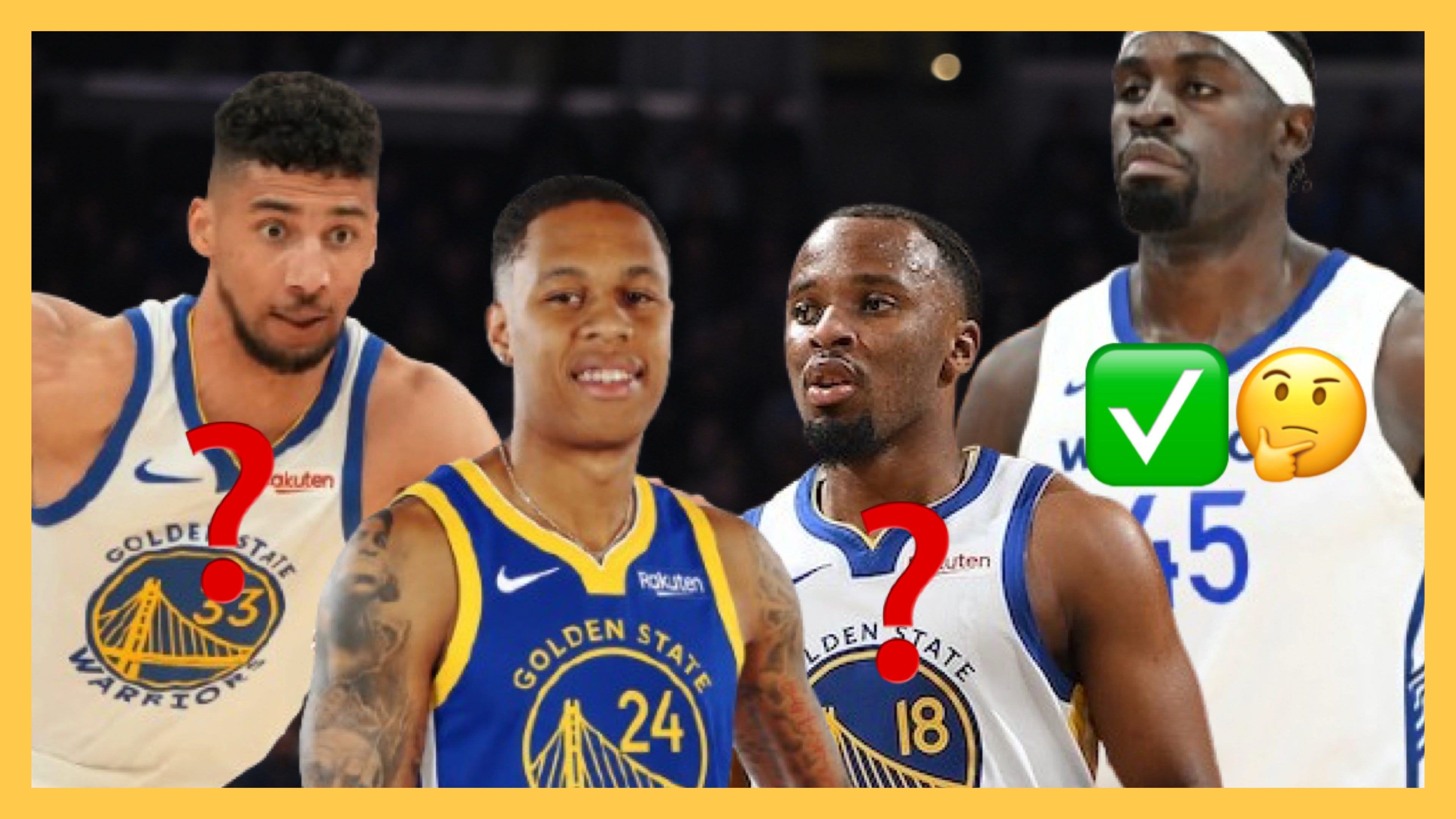
This brings us to the actual Warriors roster. Before training camp began, Brandon Williams — whose Instagram handle is “thebwill2”, but recently on the Draymond Green Show podcast, Green referred to Williams as “BDub”, perhaps to avoid confusion with Will (Richard) — looked like one of the obvious names to watch because his one-year contract was non-guaranteed, even though he’s proven he belongs as an NBA player on more than one occasion for the Dallas Mavericks in 2025-26.
Four practices into Hawaii, I have a hard time imagining Golden State simply tossing Williams aside. Steve Kerr called Williams “the fastest guy we’ve ever had here” on Friday and immediately invoked Leandro Barbosa as the closest comparison, while also describing Williams as potentially a “defensive pest” (filmed by Luca Evans of the SF Chronicle):
Draymond has raved about BDub’s speed and craft around the basket and just about everybody watching the open portions of camp has noticed how different the Warriors look when Williams injects that kind of north-south pressure into their second unit: [check the Description for the Williams timestamp]
There is also a relationship component here that shouldn’t be ignored. Williams and Melton were teammates at Crespi Carmelite, winning back-to-back California state championships together in 2015 and 2016, and Melton was among the people advocating for Williams before Golden State signed him.
Now, as the above scrimmage footage revealed, they appear positioned to share minutes in a Warriors second unit whose backcourt identity could be built around Melton’s defense and Williams’ ability to get downhill.
That doesn’t make anyone literally untouchable at the bottom of an NBA roster, but cutting Williams now after this kind of camp — and after reuniting him with Melton — would be a much stranger outcome than it looked two weeks ago. More importantly, Hawkins and Williams wouldn’t necessarily be competing to do the same thing.
Williams’ value is his burst, rim pressure and ability to create paint touches. His three-point shooting remains one of the larger questions in his game:
Do the Warriors have Brandon Williams in their back pocket?

There may very well be a “transaction after the transaction” waiting in the wings as LeBron James mulls his decision. We’ve already discussed how likely it is that the Warriors would have to get off of Moses Moody’s contract should the Non-Taxpayer Mid-Level be utilized — and, no, the contract of
Hawkins’ entire theoretical value proposition is almost the inverse: can he become such a dangerous movement shooter that the defense has to chase him around the floor, opening space for everybody else?
The Warriors could use both.
Another part of the equation changed
There is another training-camp development that makes this exercise more interesting: Graham Ike appears to be making an extremely favorable first impression.
Draymond didn’t merely compliment him this week. On his latest podcast, he told people to “buy your Graham Ike stock now,” praised his intelligence, vocal presence and passing from the high post, and went as far as envisioning Ike carving out a long NBA career:
That matters because Ike occupies one of Golden State’s three two-way slots, but it also potentially affects the standard roster indirectly. Georges Niang has looked good in camp himself and Kerr has already talked about using him as a small-ball 5, so none of this should be interpreted as me reporting that Niang is in trouble. He is also one of the league’s proven high-volume floor spacers, a career 40% three-point shooter whose skill fits what Golden State wants offensively.
But Niang is already guaranteed $1.8 million of his $3.9 million contract, will a fully guaranteed date of 1/10/2027, and Mike Dunleavy, Jr. has the Warriors operating at just $347,568 under the second apron hard cap. So replacing Niang seems all but impossible before January 10th.
With the positional need at point guard that long-range sniper LJ Cryer fills, Leons would seem to be the most obvious pressure point.
I happen to like Leons — I’m a sucker for long wings who can defend — and that would not be an insignificant decision. Leons, despite his length for point-of-attack defense and offensive rebounding, seems like a bit of a clunky fit in the new 5-out system.
So does Ike, but with Porzingis out indefinitely, Ike has become more important by default. And so, to me, Leons might end up drawing the shorter straw and that’s just how the cookie crumbles.
Hawkins is eligible for a two-way because NBA rules allow players with three or fewer years of service to sign them. If Hawkins has enough of a market to command a standard minimum contract instead, the Warriors would have to make a different choice.
Again, I could be completely wrong.
Another team may simply offer more to Hawkins than a two-way. Or the Warriors could have evaluated Hawkins three years ago, decided whatever they liked then has not translated, and have zero interest in revisiting him today.
All of those outcomes are entirely plausible and maybe there are other rabbit holes we could go down, but that is different from saying the idea itself doesn’t make sense.
Summer 2027 still intrigues me
The Warriors’ larger roster strategy makes this kind of bet even more appealing. Golden State has spent much of the past year creating flexibility for the summer of 2027 and one Wardell Stephen Curry II’s new extension only increased it. Depending on what happens with Porzingis, Podziemski, Butler, Green and various cap holds, the Warriors could have tens of millions in usable cap room next summer.
While recent projections have put their potential space roughly in the $38 million-to-$55 million range I deduced that the bottom line was that a max player slot ($61.6 million) is still available if Dunleavy really wants or needs it, even with Steph set to make $55.7 million next season.
There are decisions to be made on older or injured guys like Jimmy, Dray and KP, but unlike in the past, there may be now more optionality to keep a reclamation project like Hawkins.
As I’ve said anytime the summer 2027 cap sheet is mentioned, the market is trending towards older players not being able to secure even a Non-Taxpayer Mid-Level (NTMLE) salary, which is roughly around $16 million. The league is trending towards youth, so if Hawkins can play himself into an NTMLE-worthy rotation player — which would be astounding considering a player like Nickeil Alexander-Walker makes that amount — or even at the Bi-Annual Exception value of $9 to $10 million, or even half of an NTMLE (example: Anfernee Simons) that’s likely to be more than what a 35-year-old will be worth.
Kerr even alluded to this youth movement across the league and with the Dubs, speaking to Anthony Slater of ESPN yesterday at Day 4 of training camp in Hawaii and using the adjective “painful” to describe this overall roster transition:
If Hawkins comes here and doesn’t make it, you move on. If Hawkins looks like exactly the player New Orleans and Memphis just decided he wasn’t, you haven’t sacrificed much, but if something clicks — the shot stabilizes, the Warriors’ movement system plays to his strengths, the defensive coaching under Frank Vogel cleans up enough weaknesses to keep him on the floor, and Hawkins suddenly has one of those hockey-stick development curves we’ve watched Gui experience — then Golden State enters next summer with the financial flexibility in a rather depressed market (again, the loaded 2026 Draft has a lot to do with that) to deal with the happy problem it just created:
That is value creation and for a team trying to extend Curry’s window while simultaneously getting younger around him, those bets become more important, not less.
The Warriors don’t need Hawkins to become the player somebody dreamed about when he went No. 14 three years ago. They certainly don’t need him to become Game 6 Klay, one of the lofty names that appeared in his original NBA.com projection or even, let’s call him, “One-Game-7-Splash” Buddy.
They need to ask whether there is a path from what Hawkins is today to something more useful than what the final roster spot — or the final two-way spot — currently provides.
Can he shoot 38 or 39 percent from three instead of 34 or 35? Can anybody playing the 2 or 3 for the Warriors do that? Can Hawkins survive defensively? Can Steph and the Warriors’ screening and movement ecosystem weaponize Hawkins’ best skill more effectively than his previous teams did? Does the answer to those questions carry more upside than simply standing pat?
That is why I don’t think the Warriors’ roster is necessarily as locked as it looked 24 hours ago. I would actually be surprised if they made an about-face on any of their three current two-ways, especially with both Cryer and Leons signed last summer to two-year two-way deals. Golden State has made a not insignificant investment in each of them. Learning how to play with Steph and Dray does not happen overnight.
Still, coldly, maybe Cryer is now more expendable with the rise of Williams? I didn’t really go down that rabbit hole. But I hope that poking around with this bonafide 2-guard example helped bring to light some nuances of the Warriors roster that maybe got lost in the shuffle as our squad embarked on training camp in Hawaii.
For me, enjoying basketball up-close through the eyes of the beatwriters in attendance at BYU-Hawaii with the Warriors — particularly on our YouTube channel and our Discord “knowledge base”, if you haven’t checked those out yet — still proves:
Process >> Results
Glad you came along as we touched on various aspects of the roster through the lens of Hawkins.
And so I’ve merely been told they liked Jordan Hawkins once. I have not been told they like him now. Maybe by tomorrow we find out there is nothing here. I’m perfectly willing to live with that.
Connecting dots is not the same thing as reporting that the dots have already been connected by the team. I would much rather make that distinction clear than manufacture certainty just because it would produce a louder headline.
But when a former Lottery pick who has not yet reached his prime at age 24, whom your scouts previously liked, suddenly hits the market with $7 million already guaranteed elsewhere and the possibility that your acquisition cost could be a minimum contract or even a two-way slot, I think it is worth asking the question. That’s kind of how cap sheet nerds view the world, which is generally how the thirty GMs of the NBA and their staffs have to view the league in this era of the aprons.
If Golden State does decide Hawkins is worth another look, my read is it pretty much has to be on a two-way.
I could be wrong, but I would absolutely at least make the call to Hawkins’ agent and see where they are.
🫶💙💛
Good analysis. Thanks.
Hawkins ends up with the Bulls: https://twitter.com/ShamsCharania/status/2107229241679262063